Barometric Pressure and Dog Arthritis: The Evidence
A front rolls in, and your old dog takes an extra beat to get off the bed. Someone always says the same thing: it is the pressure. It has the ring of folk wisdom that turns out to be true, and half the pet internet repeats it as settled fact. So we went looking for the study behind it. What we found is more interesting than the myth, and it changes which dial you should actually be turning.
Key takeaways
- The strongest human study on this found weather does track joint pain, but it is the change in barometric pressure that matters, not the reading itself.
- Before that study, a systematic review of 16 papers on joint pain and weather found no consensus at all. This is a genuinely contested area, not a settled one.
- The one veterinary study to test pressure against other weather variables in the same model found atmospheric pressure was not statistically significant. Temperature was.
- Cold is the better-supported lever, and conveniently it is the one you can actually do something about.
- The practical shift: warm the dog before movement, not after. Most owners get that order backwards.
What "it is the pressure" actually claims
The usual explanation goes like this. When a low-pressure system arrives, the weight of air pressing on the body eases slightly. Tissues around a joint expand a little into that space. In a joint that is already inflamed and short on cushioning, that expansion presses on nerve endings that had no room to spare.
It is a tidy story and at least physically plausible. It is also worth keeping the scale in mind: a big weather swing moves pressure by 10 to 20 millibars, and normal sea-level pressure is around 1013. The change everyone blames is roughly one percent of the load already sitting on your dog. That does not make it impossible, but it does mean the effect should be small, and small effects are exactly the kind that are hard to prove and easy to imagine.
What the human research found
The most cited work here is a 2007 clinical research study in the American Journal of Medicine, which tracked 200 people with knee osteoarthritis over three months and matched their daily pain reports to readings from the weather station nearest each participant.
It found something. Change in barometric pressure and ambient temperature were each independently associated with pain severity, and both held up after adjusting for age, sex, body mass index, painkiller use and the previous day's pain. So the belief is not pure misattribution, which is roughly how the medical community had treated it until then. The paper is blunt about that history, noting that an earlier systematic review of 16 studies on joint pain and weather had found no consensus.
Two details matter more than the headline. First, it was the change in pressure that tracked pain, not the absolute value: a steady low-pressure week is not the thing, the front moving through is. Second, temperature came through with a smaller p-value than pressure did. Even in the study that rescued the weather theory, temperature was not the junior partner.
The one study that asked this in dogs
Human knees are not dog hips, so the honest next question is whether anyone has run this in dogs. Almost nobody has. The closest thing is a 2020 paper in Frontiers in Veterinary Science that examined 101 dogs presenting with acute intervertebral disc extrusion over six years in the Lake Geneva region, and asked which weather conditions were associated with the day symptoms began.
Crucially, it did not test one variable in isolation. It put temperature, precipitation, sunshine, humidity and atmospheric pressure into the same analysis, along with a three day lag to catch delayed effects, and let them compete.
| Weather variable | Tested in the 101-dog study? | Result |
|---|---|---|
| Ambient temperature | Yes | Significant. Odds ratio 0.89 per degree Celsius rise (95% CI 0.80 to 0.99, p = 0.0347). Colder days, more cases |
| Atmospheric pressure | Yes | Not statistically significant |
| Humidity | Yes | Not statistically significant |
| Precipitation | Yes | Not statistically significant |
| Sunshine | Yes | Not statistically significant |
Read that table against what you have been told. The variable the entire internet blames is the one that did not survive contact with the data. The variable nobody mentions is the one that did.
Two caveats, because this deserves them. Disc extrusion is not osteoarthritis: it is a spinal event in different tissue, and the population skewed toward the breeds built for it, roughly two thirds chondrodystrophic, mostly French Bulldogs and Dachshunds. And 101 dogs is a modest sample, so a small pressure effect could exist and be invisible at that size. But it is still the only place anyone made pressure and temperature compete in dogs, and pressure lost.

Why cold is the more likely culprit
Here is the confound at the heart of this, and why owner observation cannot settle it. Pressure drops and temperature drops travel together: a front is a package. If your dog is stiffer the day the storm arrives, you have two suspects who showed up in the same car, and the folk explanation has always picked the wrong one out of the lineup.
The proposed mechanisms for cold are also more concrete. PetMD's vet-reviewed guide to arthritis in cold weather lists three: synovial fluid thickens in the cold and moves less freely through the joint, ligaments and surrounding tissue carry more tension, and dogs simply move less in bad weather, which produces stiffness and muscle loss all by itself. That third one is not a weather effect at all. It is a behaviour effect wearing a weather costume, and it is probably the largest of the three.
That same guide is refreshingly honest that not everyone agrees joint pain genuinely worsens in winter. We would rather cite a source that says so out loud than one that sounds more certain than the field is.
None of this means your dog is imagining it. Osteoarthritis is real and progressive, and the signs the American Kennel Club lists (slower to rise, reluctant on stairs, losing muscle over the hips) are the same ones you notice on storm days. The argument is only about which knob the weather is turning.
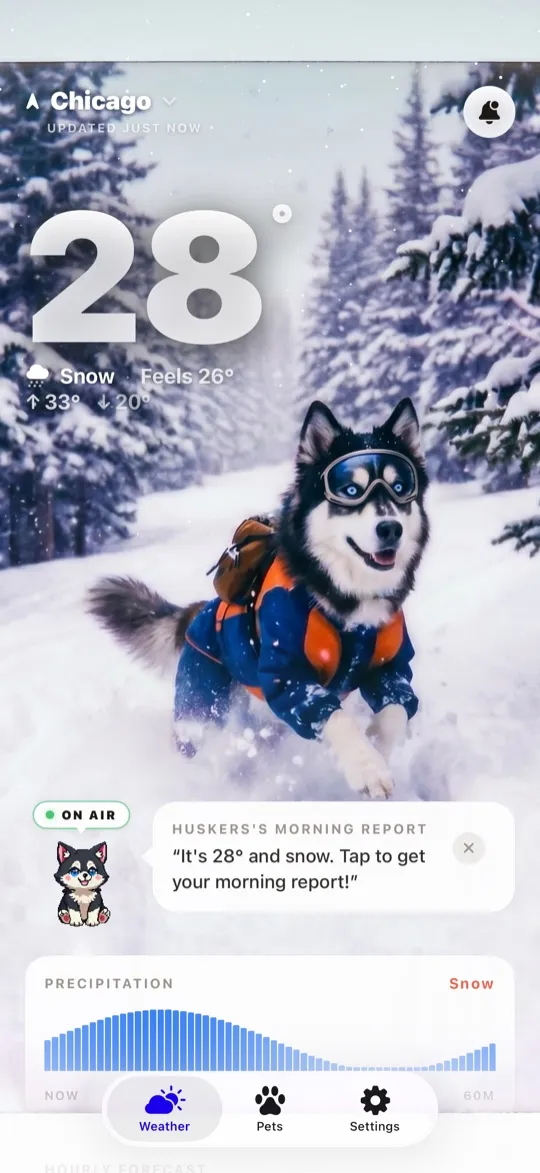
If the temperature swing is the thing that matters, then the useful information is tomorrow's low and the hour it lands, which is exactly what WeatherPets puts on your home screen next to your own dog. Meet your WeatherPet on the App Store.
What to actually do about it
Swapping the blame from pressure to temperature is not academic, because you cannot change the pressure and you absolutely can change how cold your dog gets. Here is the routine that follows from the evidence.
| Do this | Why it follows from the evidence |
|---|---|
| Warm the dog before movement, not after | Coat on indoors before the door opens. Stiffness is worst on the first few steps, exactly when most owners are still fumbling with a harness in a cold hallway |
| Three short walks, not one long one | Keeps the joint moving without a long cold exposure, and avoids the deconditioning that inactivity causes on its own |
| Get the bed off the floor and out of the draught | Floors are the coldest surface in the house and the one an arthritic dog spends the most hours pressed against |
| Put runners on slick floors | Not a weather fix, but a stiff dog slips more, and slipping turns a stiff dog into an injured one |
| Keep the weight off | Over half of dogs in the United States are overweight, and every extra pound is load on a joint that is already short on cushioning |
| Have the pain conversation before the season, not during it | Anti-inflammatories, omega-3s and physiotherapy all take time to work. Booking in October beats reacting in January |
The first habit is the highest-value one. Most of what owners read as "the storm is hurting them" is a cold dog taking its first steps of the day on a cold floor. Our guide to why older dogs feel temperature more covers why the margin narrows with age, and indoor exercise for dogs covers the days the walk genuinely should be short.

When it is not the weather
This is the part that matters most, and why "it is just the pressure" is a risky sentence to say to yourself. Arthritis comes on gradually: worse after rest, better once warmed up, changing over months rather than minutes. A spinal disc event does not behave like that at all. VCA's guide to degenerative joint disease is a good primer on the slow version. The fast version is an emergency.
Go to a vet the same day, not next week, if you see any of these:
- Sudden inability or unwillingness to use the back legs
- Crying out when picked up, touched along the back, or moving
- Dragging a paw, or knuckling it over so the top of the foot hits the ground
- A wobbly, drunk-looking gait that appeared today
- Loss of bladder or bowel control
- A hunched back with obvious reluctance to move at all
Those are the signs of the condition the 101-dog study was actually about, and it is treatable when caught fast. Note that the study found these events cluster on colder days: the exact weather you were about to blame for ordinary stiffness is also when the serious version is more likely. A good reason to check rather than assume.
Reading your own week
The practical version fits in a sentence. Stop watching the pressure and start watching the overnight low, especially the first real cold snap of the season, when owners report the sharpest change in how their old dog moves. Warm them indoors before they go out, keep outings short and frequent, and treat sudden changes as a vet question rather than a weather one. Our guide to what the feels-like number means for dogs covers why the thermometer alone understates a windy morning.
And if someone tells you it is the pressure, you now know the honest answer: maybe, a little, in humans, when it is changing. In dogs, the only people who checked found temperature instead.
Frequently asked questions
Can dogs feel barometric pressure changes?
Probably, in the sense that dogs clearly react to approaching weather, but the joint-pain part is not established. The only veterinary study to put atmospheric pressure into a model alongside temperature, humidity, sunshine and rainfall found pressure was not statistically significant. Temperature was. So a dog reacting to an incoming storm is real, and blaming the pressure specifically for the stiffness is a bigger claim than the evidence supports.
Does cold weather make dog arthritis worse?
This is the better-supported half of the question. In humans, ambient temperature was independently associated with knee osteoarthritis pain in a 200 person study. In dogs, colder temperatures were associated with acute disc extrusion at odds of 0.89 per degree Celsius rise. The proposed mechanisms are thicker joint fluid, more tension in ligaments, and simply moving less in winter, which causes stiffness on its own.
Why is my dog stiff before a storm?
A front brings a pressure drop and a temperature change together, so the two are almost impossible to separate by watching one dog. Human research found it is the change in pressure rather than the absolute reading that tracks pain, which fits the pattern of a dog being worse while the front moves through and better once it has settled. The temperature swing riding along with it is at least as likely to be the culprit.
How can I tell if it is arthritis or something more serious?
Arthritis is gradual and symmetrical-ish: slower to rise, reluctant on stairs, lagging on walks, stiff after rest and looser once warmed up. Sudden onset is the red flag. A dog that cannot use its back legs, is crying out, is dragging a paw, has gone wobbly, or has lost bladder control needs a vet immediately, because that pattern fits a spinal disc rather than a bad weather day.
What temperature is too cold for an arthritic dog?
There is no single number, because it depends on the dog's size, coat and condition. The practical approach is to treat an arthritic dog as one category colder than the same dog would be without arthritis: warm the dog before the walk rather than during it, keep outings shorter and more frequent, and pay attention to the first cold snap of the season, which tends to produce the sharpest change in how they move.
Your daily forecast, delivered by your own pet.










A note on health: This article is general information, not a substitute for professional veterinary advice. If your dog is suddenly unable to use its back legs, is in obvious pain, or you have any serious or emergency health concern, contact your veterinarian right away. Our guidance draws on trusted veterinary and peer-reviewed sources, including those linked above.
