Dogs on Restaurant Patios: The Rules by State
It is a perfect evening, the patio is half empty, and your dog is sitting politely at your feet. Then a manager walks over. Whether the next sentence is "what a good girl" or "sorry, we cannot have dogs here" comes down to a stack of rules most owners have never read: a federal model code, a state law or regulation, a county health department, and the restaurant's own decision. Here is how that stack actually works, which states permit patio dogs, and the etiquette that keeps you invited back.
Key takeaways
- The 2022 FDA Food Code allows it, conditionally. Restaurants may permit pet dogs in outdoor dining areas only where the local regulatory authority approves.
- 23 states have a statewide law or regulation expressly permitting dogs in outdoor dining areas. Elsewhere it is usually decided city by city.
- Legal does not mean allowed. Restaurants opt in. Any of them can still say no, and many do.
- Outdoor only, floor only, leash always. Nearly every rule set bans dogs from indoor areas, furniture, and contact with staff or tableware.
- Service dogs are a different question entirely. The ADA governs them, not patio pet policies.
- Weather decides more than the law does. A hot patio with no shade is a bad idea even where dogs are welcome.
The short answer: yes, if four things line up
There is no single national rule that says dogs may sit on patios. What you get instead is a chain of permissions, and every link has to hold.
- The model code. The FDA publishes the Food Code, a model that states and localities adopt in whole or in part. The 2022 edition amended the "prohibiting animals" section (6-501.115) to add an allowance for pet dogs in outdoor dining areas where approved by the regulatory authority. You can read the change in the FDA's summary of changes to the 2022 Food Code.
- Your state. A state either passes a statute, writes the allowance into its own food regulations, or does neither.
- Your local health department. This is the "regulatory authority" in most places. It approves the restaurant, and it often adds requirements about signage, entrances, and cleaning.
- The restaurant. Even fully permitted, the business chooses. Paperwork, staff training, and liability mean plenty of eligible places never opt in.
That last link is the one owners forget. These laws are permissive, not mandatory. Nobody is required to seat your dog.
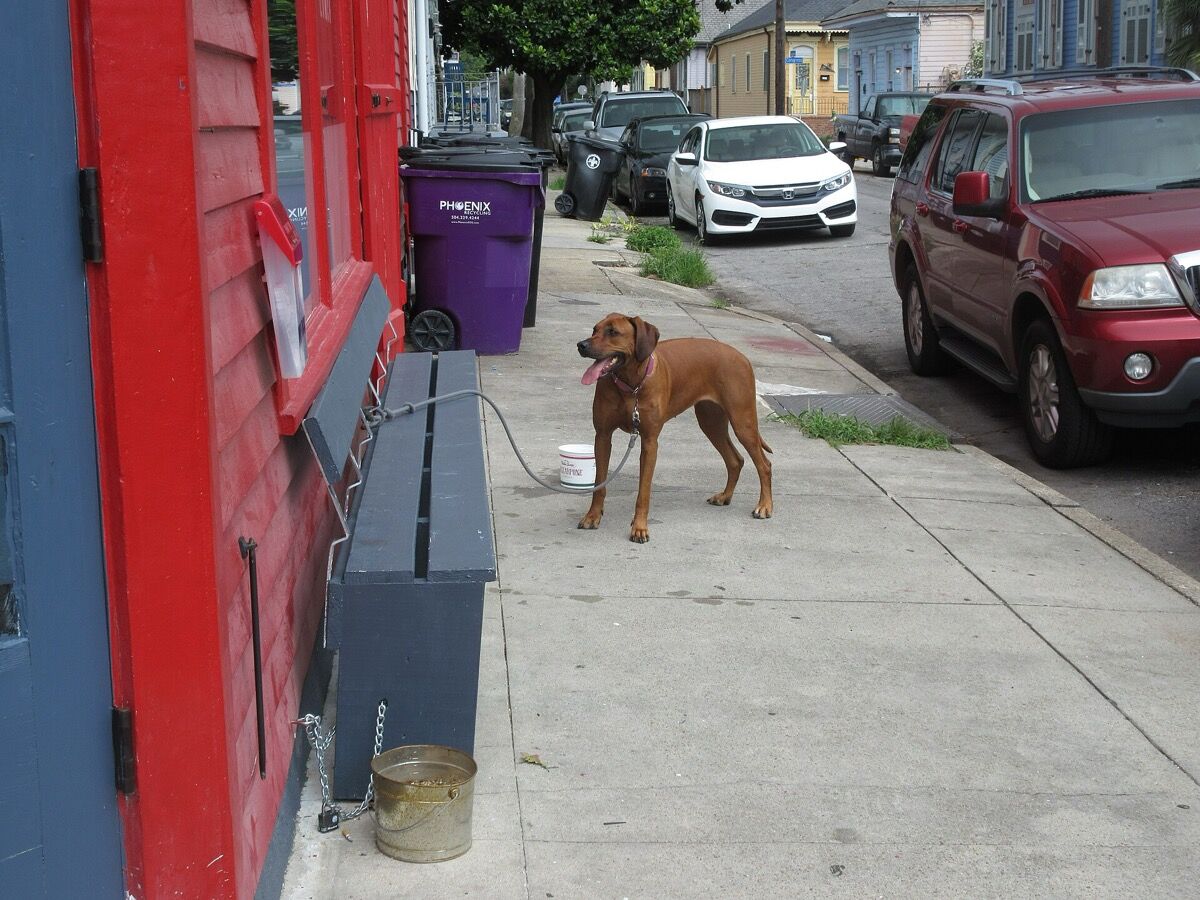
States that permit dogs in outdoor dining areas
The table below is drawn from the Animal Legal & Historical Center at Michigan State University College of Law, which tracks these provisions by state. Seventeen states permit patio dogs by statute and eight by regulation, with Kentucky and Virginia appearing in both categories, for 23 unique states.
| State | How it is permitted | Year |
|---|---|---|
| Alabama | Statute | 2021 |
| California | Statute | 2014 |
| Colorado | Statute | 2020 |
| Delaware | Statute | 2020 |
| Florida | Statute | 2006 |
| Georgia | Regulation | Not specified |
| Illinois | Statute | 2008 |
| Iowa | Regulation | 2020 |
| Kentucky | Statute and regulation | 2023 |
| Maryland | Statute | 2011 |
| Minnesota | Statute | 2008 |
| New Hampshire | Statute | 2022 |
| New Mexico | Statute | 2011 |
| New York | Statute | 2015 |
| North Carolina | Regulation | Not specified |
| Ohio | Statute | 2018 |
| Oklahoma | Regulation | Not specified |
| Rhode Island | Statute | 2016 |
| South Carolina | Regulation | Not specified |
| Tennessee | Statute | 2009 |
| Texas | Statute | 2019 |
| Virginia | Statute and regulation | 2018 |
| Washington | Regulation | 2021 |
If your state is not on the list, do not assume the answer is no. Many states leave it to local government, and a city or county ordinance can create the same allowance. Some states also let a local unit of government adopt an ordinance that operates as an exemption to the state food code. The practical move is to check your county or city health department's food-establishment rules, then check the restaurant.
What the rules almost always require
State to state, the conditions rhyme. Whether the language comes from a statute, a health regulation, or a restaurant's own policy, expect most of this list. Georgia's health department, for example, publishes a plain-language dogs-in-restaurants FAQ covering exactly these points.
- Outdoor areas only. Patios, decks, courtyards, sidewalk seating. Never the dining room, never the kitchen.
- Outside access. Patrons and dogs generally have to reach the patio from outdoors rather than walking through the restaurant.
- Leashed and controlled at all times. No retractable leashes sprawled across walkways, no off-leash "she is friendly."
- No furniture, no tableware. Dogs stay off chairs, tables, benches, linens, and utensils. If a dog touches a table, the whole table gets cleaned and sanitized before the next guest.
- Staff keep their hands off. Employees are typically barred from petting or handling dogs, and must wash up if they do. It is a food-safety rule, not a personality flaw.
- Waste handled immediately. Accidents get cleaned and the area sanitized right away, with a cleanup kit kept nearby.
- Single-use bowls. Water and treats come in disposable containers, not restaurant dishware.
- Posted signage. Most jurisdictions require a visible sign explaining the rules to patrons and staff.
The National Restaurant Association's guidance for operators covers the same ground from the other side of the table, which is a useful read if you want to understand why a server may seem strangely uninterested in your extremely pettable dog.
Service dogs are not part of this question
Everything above concerns pet dogs. A trained service dog is governed by the Americans with Disabilities Act, which allows a person with a disability to be accompanied by their service animal in areas open to the public, indoors included. Restaurants may ask only two questions: whether the dog is required because of a disability, and what work or task it has been trained to perform. They may not demand documentation or ask about the disability. Emotional support animals, by contrast, do not carry the same public-access rights and are treated as pets for restaurant purposes, which is exactly the distinction that trips people up at the host stand.
The part the law does not cover: is the patio actually good for your dog?
Permission is one thing. A dog lying on dark pavers in late-afternoon August sun for ninety minutes is another. Patios concentrate heat: stone and composite decking bake, umbrellas move with the sun, and the surface your dog is lying on can run well above air temperature. Our seven-second pavement test is the fastest field check, and the thresholds in what temperature is too hot to walk your dog apply just as well to sitting still outdoors.
A few practical rules that have nothing to do with statutes:
- Book the shaded side, or go after the sun drops below the buildings.
- Bring your own collapsible bowl and water. Do not rely on the restaurant.
- Watch for heavy panting, seeking cooler ground, or refusing to settle. Those are your cues to leave, not to order dessert. Our guide to heatstroke warning signs covers what escalation looks like.
- Humid evenings are harder than the thermometer suggests, because panting works poorly when nothing evaporates.
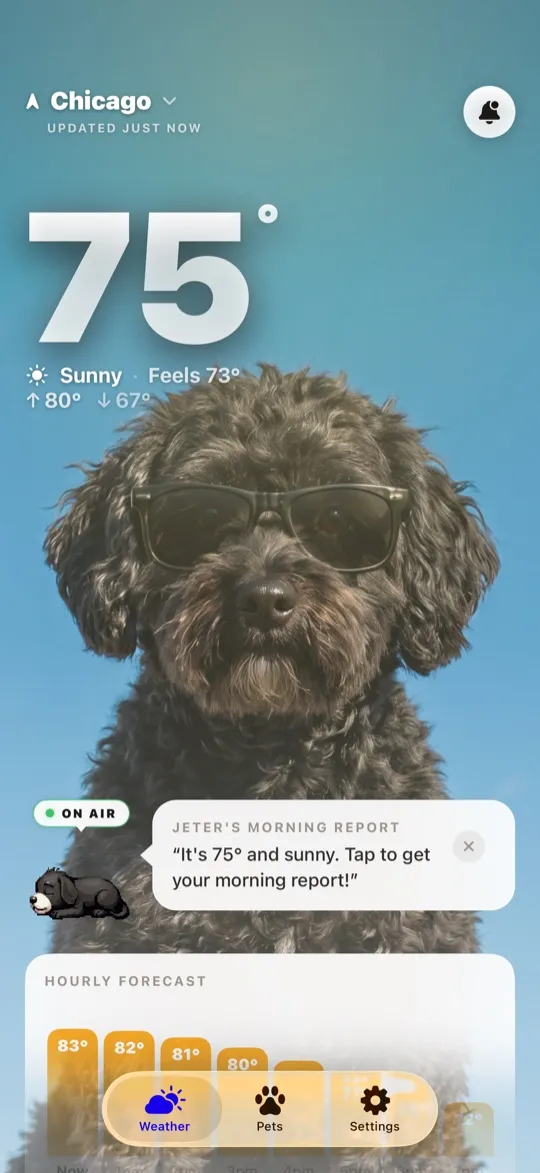
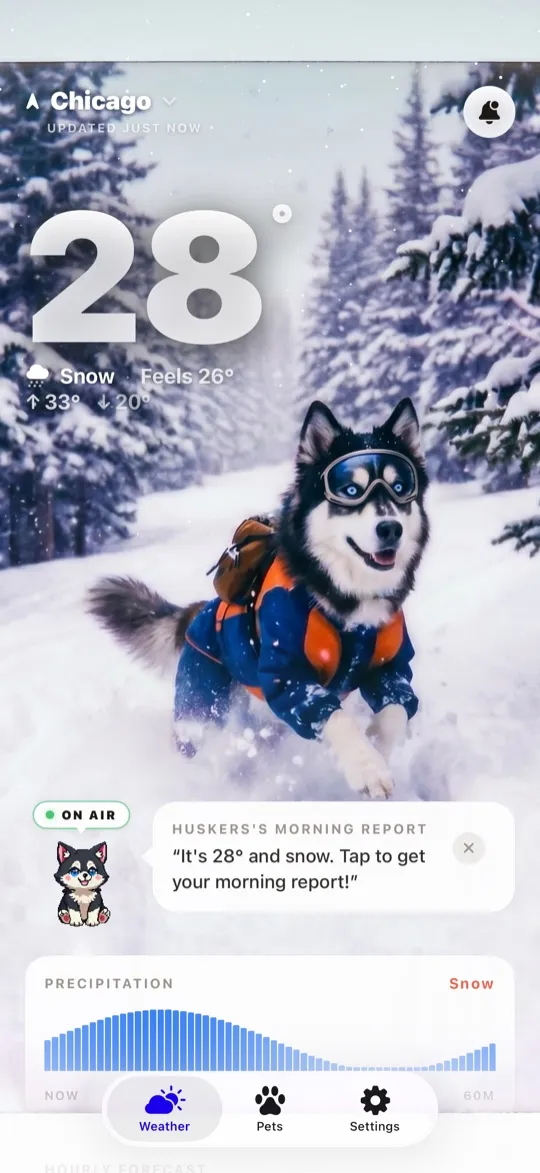
The difference between a great patio night and a miserable one is usually two hours of timing. WeatherPets puts the afternoon high, the humidity, and a Live Activity in front of you as your own pet, so picking the right hour stops being guesswork. Meet your WeatherPet on the App Store.
Patio etiquette that keeps dogs welcome
Dog-friendly patios exist because enough owners behaved well enough that health departments and restaurants took the risk. The fastest way to lose one is a bad afternoon. A short pre-flight check:
- Call first. One question, answered in ten seconds, beats an awkward walk-out.
- Be honest about your dog. A dog that barks at strangers, lunges at food, or cannot settle for an hour is not a patio dog yet. Practice at a quiet coffee shop first.
- Take the outside seat. Tuck your dog under the table on the wall or railing side, out of server traffic lanes.
- Short leash, hands on it. Not clipped to a chair that can be dragged.
- Potty before, not during. Walk the block first.
- No table feeding. Bring treats if you must, and keep them off restaurant surfaces.
- Leave early if it is not working. A dog who is overheating, overstimulated, or vocal is telling you the visit is over.
- Tip well. Someone is cleaning under that table.
How to check before you go
Three searches, about two minutes:
- Search your county or city health department for "outdoor dining dogs" or "pet dogs food establishment" to find the local rule and any permit list.
- Check the restaurant's own site or listing for a dogs-welcome note, and look for the required signage in photos of the patio.
- Call and ask two questions: do you allow dogs on the patio, and is there a section you prefer we sit in?
Then check the forecast, because the patio you can legally use at 2pm in July is often not the patio you should use at 2pm in July. If you are hunting for reliably dog-friendly outdoor spots near you, our pet place finder is a good starting point for parks and pet-friendly stops in your area.
Frequently asked questions
Can you bring your dog to a restaurant patio?
Often yes, but it is never automatic. The 2022 FDA Food Code lets food establishments allow pet dogs in outdoor dining areas only if the local regulatory authority approves it. About 23 states have a statewide law or regulation permitting it, and many cities allow it by local ordinance. Even where it is legal, each restaurant chooses whether to opt in, so call ahead or look for a posted dogs-welcome sign.
Are dogs allowed inside restaurants?
Almost never. State laws and health regulations that permit pet dogs are limited to outdoor dining areas, and they usually require that the patio be reachable from outside so dogs never pass through indoor food-service space. Trained service dogs are a separate category under the Americans with Disabilities Act and may accompany their handler indoors.
Which states allow dogs in outdoor dining areas?
According to the Animal Legal & Historical Center, 17 states permit it by statute: Alabama, California, Colorado, Delaware, Florida, Illinois, Kentucky, Maryland, Minnesota, New Hampshire, New Mexico, New York, Ohio, Rhode Island, Tennessee, Texas and Virginia. Georgia, Iowa, Kentucky, North Carolina, Oklahoma, South Carolina, Virginia and Washington allow it by regulation, for 23 unique states in total. Local health departments still set the details.
Can a restaurant refuse my dog even if my state allows patio dogs?
Yes. These laws permit restaurants to allow dogs, they do not require it. Owners must usually apply for or notify the local health department, post signage, and follow cleaning and handling rules, so plenty of eligible restaurants simply opt out. A refusal at the door is the restaurant exercising its choice, not breaking the law.
Can my dog sit on a chair at a restaurant patio?
No. Nearly every rule set keeps dogs off chairs, tables, benches and other furniture, and off linens, tableware and food-service items. If a dog does get on a table, the establishment has to clean and sanitize the entire table and everything on it before seating anyone else. Dogs stay on the floor, on a leash, next to your seat.
Is a service dog treated the same as a pet dog on a patio?
No. Under the Americans with Disabilities Act, a trained service dog that performs tasks for a person with a disability may accompany its handler in areas open to the public, including indoors, and is not subject to patio pet policies. Emotional support animals do not carry the same public-access rights and are treated as pets for restaurant purposes.
Deciding whether to go is the hard part of every walk. The Pet Safety Score in WeatherPets answers it with one 0 to 100 number for your specific pet, plus the best and worst walk windows for the next 24 hours. Meet your WeatherPet on the App Store.
Your daily forecast, delivered by your own pet.







A note on the rules: This article is general information, not legal advice, and food-service rules change. State laws, local health department requirements, and individual restaurant policies all vary, so confirm the current rules with your local health department and the establishment before you go. State-by-state details above reflect the Animal Legal & Historical Center's published summary as of July 2026.
A note on health: This article is general information, not a substitute for professional veterinary advice. If you are worried about your dog overheating while you are out, or about any serious or emergency health concern, contact your veterinarian right away. Our guidance draws on trusted veterinary sources, including those linked above.
