Frozen Ponds and Dogs: How Thin Ice Turns Deadly
Search this and you get rescue videos. Firefighters in dry suits, a wet retriever, a happy ending. What almost nobody publishes is the bit that would have prevented it: a way to look at last week's weather and work out that the ice on your local pond could not possibly be thick enough yet.
Key takeaways
- Never follow a dog onto ice. Call emergency services and call the dog from the bank. Rescuers end up pulling out owners too.
- A cold week can prove ice is not ready. It can never prove it is. The math only works in one direction, and that is the useful direction.
- New ice grows about an inch per 15 freezing degree days, but only while thin. After that it insulates itself and growth slows sharply.
- Snow on the ice slows growth dramatically. A cold snowy week can leave thinner ice than a colder clear one.
- The edge is the least predictable part of any pond, and it is the part a dog reaches first.
Quick answer: your dog just went through the ice
Do not go onto the ice. Do not go in the water. Call 911 or your local emergency number and say a dog is through the ice and where. Then get low on the bank and call your dog, loudly and normally. Dogs often get themselves out this way, swimming toward a voice they know and hauling out where the ice is strongest. If you can reach something long from solid ground, lie flat to spread your weight. Never take a step onto ice you would not take blindfolded.
Once the dog is out it is a cold emergency, and it does not end at the shoreline. Dry and wrap the dog, warm it gradually rather than with direct heat, and watch for shivering that stops, lethargy or weakness, pale or grey gums, and slow or shallow breathing. Shivering that stops is not recovery; it is the sign to stop reading and drive. Call your vet either way and tell them how long the dog was in and how cold the water was.
The rest of this article is the part that comes before all that: why the ice was never going to hold, and how to know from your own forecast.
How ice thickness relates to the last week's lows
Ice growth is predictable in one narrow sense, and it settles the "but it has been cold all week" argument.
The unit is the freezing degree day, or FDD: take 32°F, subtract the day's average temperature. A day averaging 20°F contributes 12. A day averaging 30°F contributes 2. Days above freezing contribute nothing and undo progress. Note it is the daily average, not the overnight low, which is the mistake most people make running this in their head.
Ice growth is modelled with Stefan's equation, which the peer-reviewed literature, including the Cryosphere study of Alaskan ice growth curves, writes as thickness equal to a coefficient times the square root of accumulated FDD. The coefficient carries everything local: snow, wind, cloud, depth.
The familiar field shorthand for the early, thin part of that curve is about one inch per 15 accumulated FDD. It is a rule of thumb, not a standard, and it runs ahead of reality once the sheet thickens, which makes it good for exactly one purpose: the soonest a pond could have reached a thickness. On that basis:
| Average daily temperature | FDD per day | Earliest possible 4 inches |
|---|---|---|
| 30°F | 2 | 30 days |
| 28°F | 4 | 15 days |
| 25°F | 7 | 9 days |
| 20°F | 12 | 5 days |
| 15°F | 17 | 4 days |
| 10°F | 22 | 3 days |
Now the two caveats that make this a disqualifier rather than a green light. They matter more than the table.
The linear shorthand expires almost immediately. It tracks the curve only while ice is thin. After that the sheet insulates the water beneath it and growth slows toward that square root, so doubling the cold does not double the ice.
Snow matters more than cold. The same Cryosphere analysis partitioned the variation in maximum ice thickness and found that on the Barrow Peninsula only 32% was explained by accumulated freezing degree days, while 68% was explained by the coefficient, which is dominated by snow insulation. The authors conclude that snow plays the dominant role in determining maximum ice thickness in most lake and river settings.
Read that against a real winter. A week at 20°F with eight inches of snow on the pond can leave less ice than a week at 24°F with a bare, wind-swept surface. The forecast that feels more wintry produced the weaker ice.
So here is the only safe way to use any of this. If the accumulated FDD says four inches is not yet possible, that is a real answer and the pond is out. If it says four inches is possible, you have learned nothing about your pond, because you do not know its snow cover, springs, currents or depth. Rule out, never rule in.
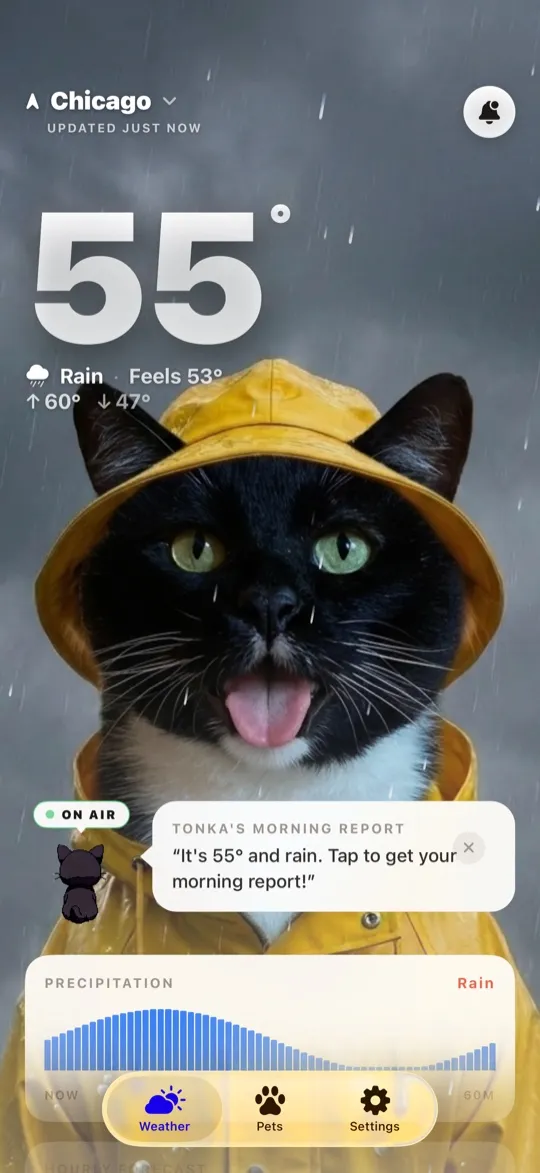
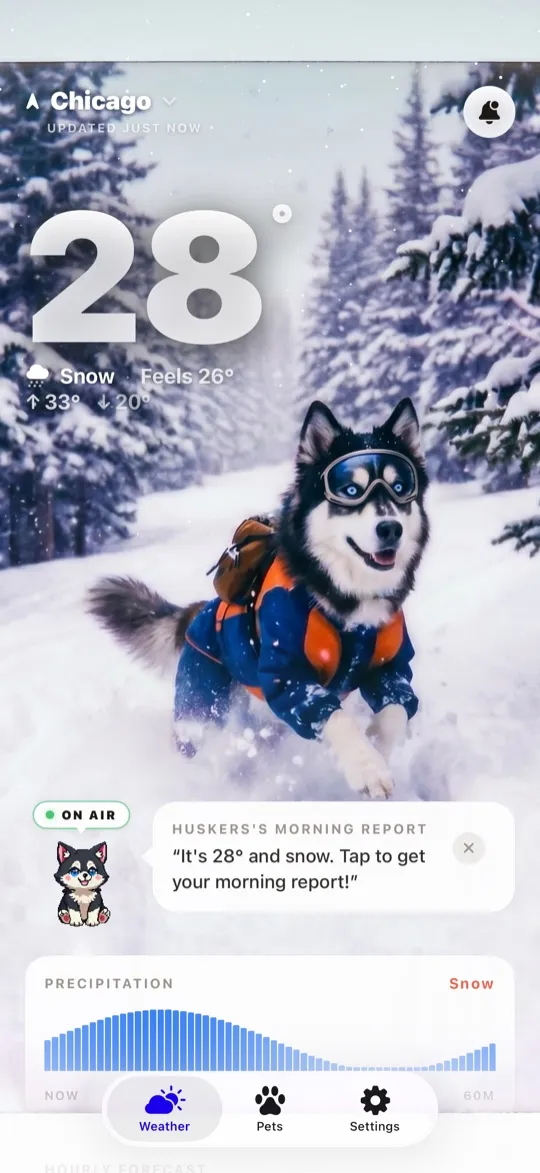
Running freezing degree days by hand means digging out seven daily averages and adding them up. WeatherPets already has the hourly history and the ten day outlook for your location, so you can see at a glance whether this cold snap has been going long enough to matter, and whether the thaw that undoes it is coming on Thursday. See how the Pet Safety Score works, or get it free on the App Store.
Why the edge is thinnest
The middle of a pond is at least consistent. The edge is where everything that weakens ice tends to live, and it is the part a dog reaches in its first stride.
The Minnesota Department of Natural Resources puts it most concretely: ice is seldom the same thickness over a single body of water, and can be two feet thick in one place and one inch thick a few yards away. The factors it lists are air temperature, wind, snow, streams, narrow areas or bottlenecks, sun, shade, plant decay, springs, currents and rough fish. Look at where those cluster on a small pond:
- Inlets and outlets. Moving water resists freezing and undercuts ice from below. On most ponds these are at the margins.
- Springs. Invisible from the bank, and warmer than the pond.
- Decaying vegetation. Reed beds and weed margins generate a little heat and a lot of weak, honeycombed ice.
- Docks, posts and moored boats. Dark objects absorb sun and conduct heat, thinning a ring around themselves.
- Shallow shelves. They freeze first, which is why they look reassuring and invite the first step.
The DNR also notes that white ice, formed when snow melts and refreezes on top, is only about half as strong as new clear ice, and says to double the thickness guidelines when travelling on it. On a pond that has had snow on it, most of what you are looking at is white ice.
If the dog goes through: what to do, what not to do
The steps are at the top of this article, where someone searching mid-emergency needs them. What belongs here is why the first and hardest instruction is the one people break.
The ice that failed under 30kg of dog will fail under you, and cold water immersion takes your breath and your grip inside a minute. It is a common enough pattern that rescuers plan for it: in April 2026, crews in Winthrop, Maine rescued a man alongside the dog he had paddled out after by canoe on Upper Narrows Pond. Fire departments carry ice rescue suits and boards and do this routinely; you have a coat and a leash.
People also underestimate how fast the cold works after the rescue. Our guide to fall water temperature and dogs covers how quickly cold water pulls heat out of an animal, far faster than cold air at the same temperature. A dog that walks out of the water is not yet out of trouble.
Leash rules near water in winter
Every ice rescue story starts the same way, and it is never a dog deciding to test the ice. It is a dog following something.
Geese sit on frozen ponds. Deer cross them. A dog whose recall is reliable in a field in July is not the same dog when a goose lifts off fifty yards out on a flat white surface that reads as ground. This is an argument for equipment rather than training.
- Leash on within sight of any frozen water, all winter, regardless of recall. One rule, no judgement calls, which is why it works.
- Change the winter route if it runs along a pond. It costs nothing and removes the situation.
- A snow-covered pond is invisible to your dog. A field and a frozen pond under six inches of snow look identical from a dog's height.
- Watch the melt as well as the freeze. The first mild days after a hard freeze produce ice that still looks solid and is not.
The wider cold-weather picture, including how long a dog should be out in the temperatures where all this applies, is in our guide to cold weather safe temperatures for dogs. The American Veterinary Medical Association's cold weather guidance makes the same point about ice from the veterinary side.
The one line worth keeping
Every winter, fire departments post the same request after pulling a dog out: stay off the ice, and keep your pets off it. They are the people who see what happens when a family decides that this particular pond, this particular week, is probably fine.
You can run the freezing degree days and satisfy yourself the ice is definitely not ready. That is worth doing. You cannot run any calculation that makes it safe, and the National Weather Service's winter safety guidance does not offer one either.
Frequently asked questions
How thick does ice need to be for a dog?
There is no published thickness for dogs. Minnesota's Department of Natural Resources says stay off under 4 inches and treats 4 inches of new clear ice as the minimum for a person on foot. A dog weighs less than an adult but concentrates its weight on four small points and runs rather than walks, so treat 4 inches as a floor rather than a clearance. The DNR also says ice is never 100% safe.
What do I do if my dog falls through ice?
Do not go onto the ice or into the water. Call 911 or your local emergency number immediately and say a dog is in the ice, then call the dog from the bank, because a dog swimming toward a familiar voice can often get itself out. Lie flat if you must approach at all, and reach with something long. People die doing this: in one 2026 incident in Maine, crews ended up rescuing both a dog and the man who had gone out after it.
Why do dogs go onto ice?
Mostly because it does not read as water to them. A frozen pond looks like more ground, and in winter it is often the open, flat, inviting bit of the landscape with geese or a deer sitting on it. A dog does not test the ice; it follows something onto it. That is the argument for a leash near water in winter rather than for better recall, because recall is what fails when a bird lifts off.
Does a cold week mean the ice is safe?
No, and this is the misconception that puts dogs in the water. New ice grows at roughly an inch per 15 freezing degree days only while it is thin, then slows sharply because ice insulates the water beneath it. Snow on top slows it much further. A cold snowy week can produce less ice than a colder clear one, so a cold forecast can tell you ice is definitely not ready yet, and can never tell you it is ready.
Is ice thicker near the shore?
Sometimes, and it is always the least predictable part of the pond. Inlets and outlets, springs, narrow bottlenecks, currents, docks and decaying vegetation all weaken ice, and most of those sit at or near the edge. The Minnesota DNR puts it starkly: ice can be two feet thick in one place and one inch thick a few yards away.
Can my dog get hypothermia from falling in?
Yes, and it can continue after the rescue. Get the dog dry, wrap it, warm it gradually rather than with direct heat, and call your vet even if it seems fine, because cold-water immersion is one of those events where the animal can look better than it is. Tell the vet how long the dog was in the water and how cold it was.
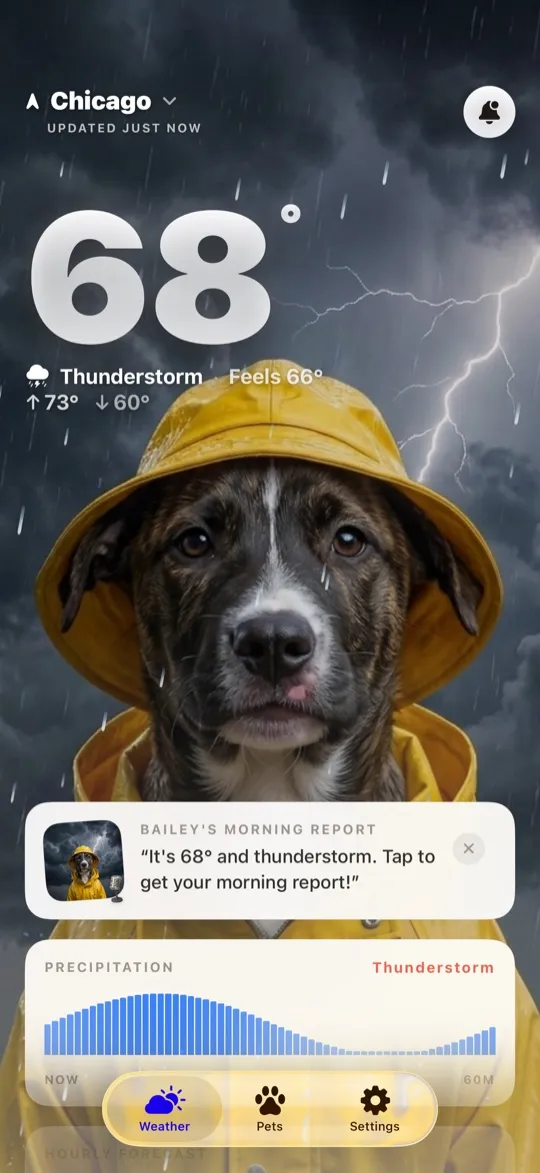
Your daily forecast, delivered by your own pet.








A note on health: This article is general information, not a substitute for professional veterinary advice. If you are worried about hypothermia or a cold-water immersion or any serious or emergency health concern, contact your veterinarian right away. Our guidance draws on trusted veterinary and government sources, including those linked above.
