Tornado Warning With Pets: Where to Actually Shelter
Every guide to tornadoes and pets says the same sentence: bring your pets with you to your safe place. It is correct, and on its own it is close to useless, because nobody fails at intending to bring the cat. They fail at the ten minutes, in the dark, with the phone screaming, when the cat is already under the bed and the crate is in the garage.
Key takeaways
- The watch is the part that matters. A watch can run for hours; a warning is minutes. Everything involving catching, carrying or crating an animal belongs in the watch.
- The National Weather Service's own instruction for a warning is an interior room on the lowest floor of a sturdy building, away from windows. Your pets go in that room, contained.
- Measure the room before storm season. The safe spot was chosen for people. Two crates and a bathroom door that opens inward is a problem you want to find in March.
- Mobile home plus pets means leaving at the watch. There is no version of this that works once a warning is issued.
- More pets are lost after tornadoes than hurt during them. Fences fail, doors fail, and frightened animals run. Tags, a registered microchip and current photos are the cheap insurance.
Two alerts, two completely different jobs
Almost all of the useful planning happens in a stage most people treat as background noise. The National Weather Service's own explanation of tornado alerts is worth reading in full, but the short version is that a watch means tornadoes are possible across a large area, often several counties or states, and that you should review your plan and check your safe room. A warning means one has been sighted or shown on radar, that there is imminent danger, and that you should move now. Warnings cover a small area, roughly a city or a small county.
Translate that into pet terms and the whole problem reorganises itself. Anything that requires cooperation from an animal has to happen at the watch. Anything that happens at the warning has to be something you can do in under a minute while carrying things.
| Stage | What it means | What you do with the pets |
|---|---|---|
| Tornado Watch | Conditions are favourable across a wide area. Hours of notice | Everyone comes indoors. Carriers out and open in the shelter room. Collars and harnesses on. Go-bag moved to the room. Cat located, not just assumed |
| Tornado Warning | Sighted or radar-indicated. Imminent danger, minutes of notice | Cat into the carrier, dog on a leash you are holding, everyone into the interior room on the lowest floor. Doors shut behind you |
| Tornado Emergency | The NWS's highest alert. A violent tornado confirmed on the ground | Nothing new. If the watch work was done, you are already where you need to be. Cover heads, stay low, stay put |
| Afterwards | The storm has passed and the property may be open | Nobody goes outside loose. Leash for every trip out, and walk the perimeter yourself before you trust a fence |
Where to actually shelter
The NWS instruction for a warning is direct: move to an interior room on the lowest floor of a sturdy building and avoid windows. Ready.gov's tornado guidance puts a purpose-built safe room or storm shelter first, then says the next best protection is a small, interior, windowless room or basement on the lowest level of a sturdy building. It also says, in as many words, to plan for your pet.
In most homes that lands on a downstairs bathroom, a closet under the stairs, or a basement corner. Which is where a pet-specific problem appears that no safety page mentions: the room was chosen for the number of people in the house.
So do the boring thing well before you need it. Put the crates in the room and shut the door. See whether it closes. See whether two adults, a dog crate and a cat carrier actually fit, and whether the door opens inward onto the space you were planning to put the carrier in. A hallway with no windows often beats a small bathroom once there are animals involved. Finding that out during a warning is the worst possible time.
If you live in a mobile home, the answer is different and it is not negotiable. The NWS says to move to the closest substantial shelter. With pets, that has to happen at the watch, because loading two carriers and a dog into a car takes several minutes you will not have. Know the building, know whether it accepts animals, and go early enough that leaving is uneventful.
The carrier is the plan
Containment is not about restraint, it is about debris and doors. A loose animal in a room where a window may fail is a problem for the animal and for you, and a frightened dog that gets past you in the aftermath is the most common way this goes wrong.
Three things make it work:
- The carrier lives in the house, not the loft. Ready.gov's pet preparedness guidance points out that pets need to be comfortable with a carrier before an emergency, which is impossible if the carrier only ever appears on the way to the vet. Leave it out during severe weather season with a blanket in it, and it stops being a trap.
- Cats get confined at the watch. Every experienced owner knows the twenty seconds it takes for a cat to become unreachable. Do it while the evening is still boring.
- Dogs wear a harness, not just a collar. A panicking dog backs out of a flat collar. Keep a leash clipped and in your hand, not looped over a door handle.
If your dog already struggles with ordinary storms, none of this will go smoothly on the night, and the fix is not on the night. Our guide to thunderstorm anxiety in dogs and the pre-season storm prep routine both cover the desensitisation work that makes an emergency crate feel like a normal crate.
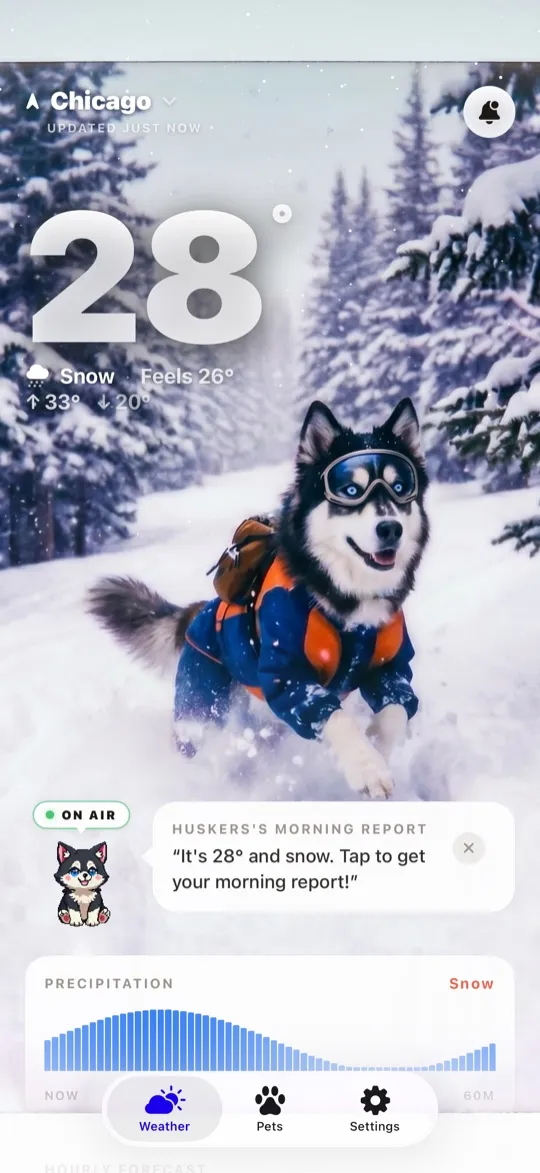
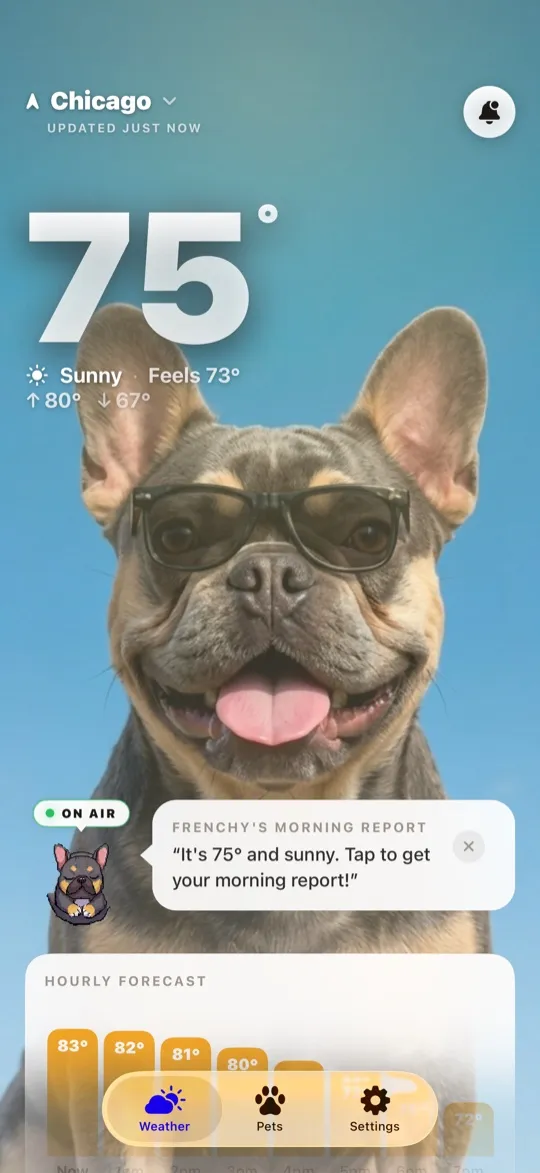
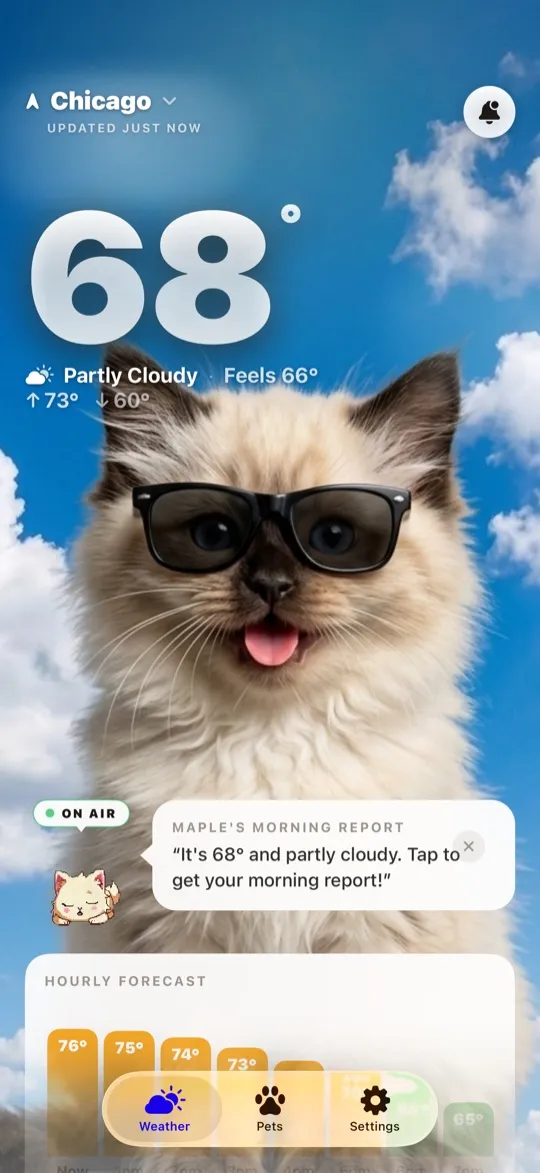
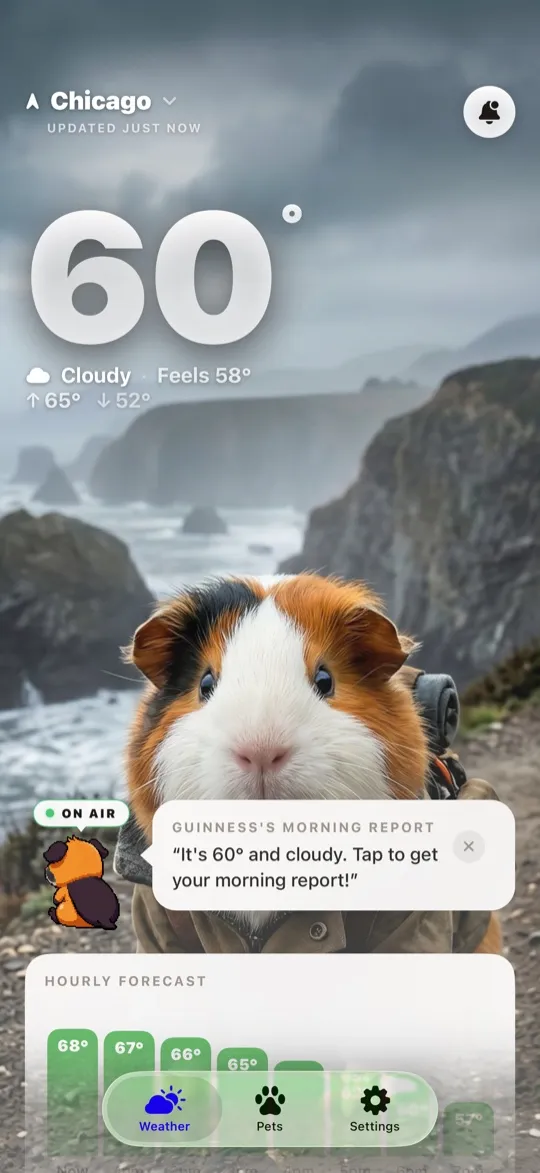
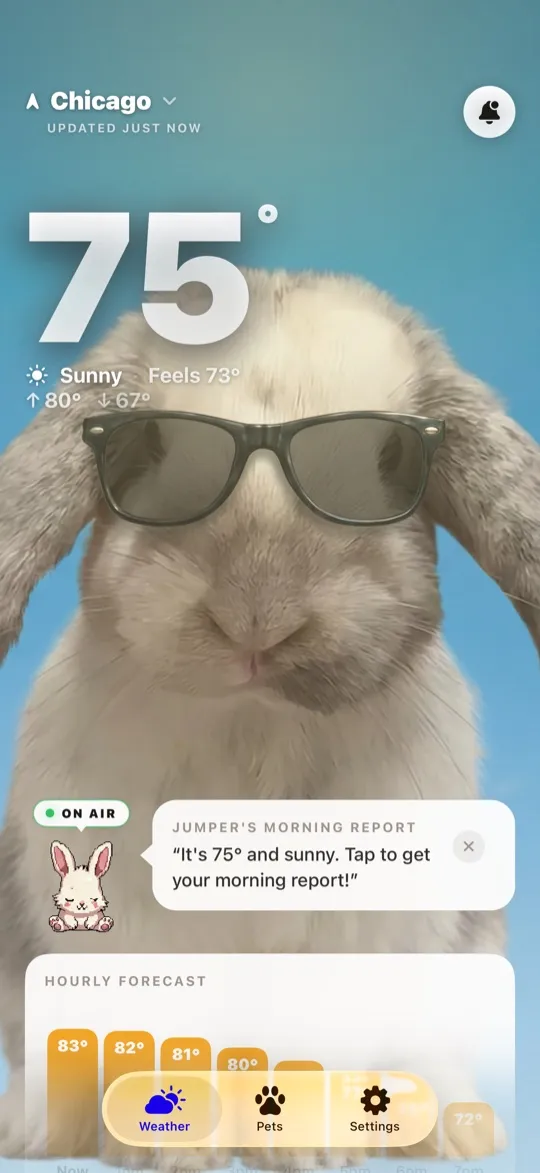
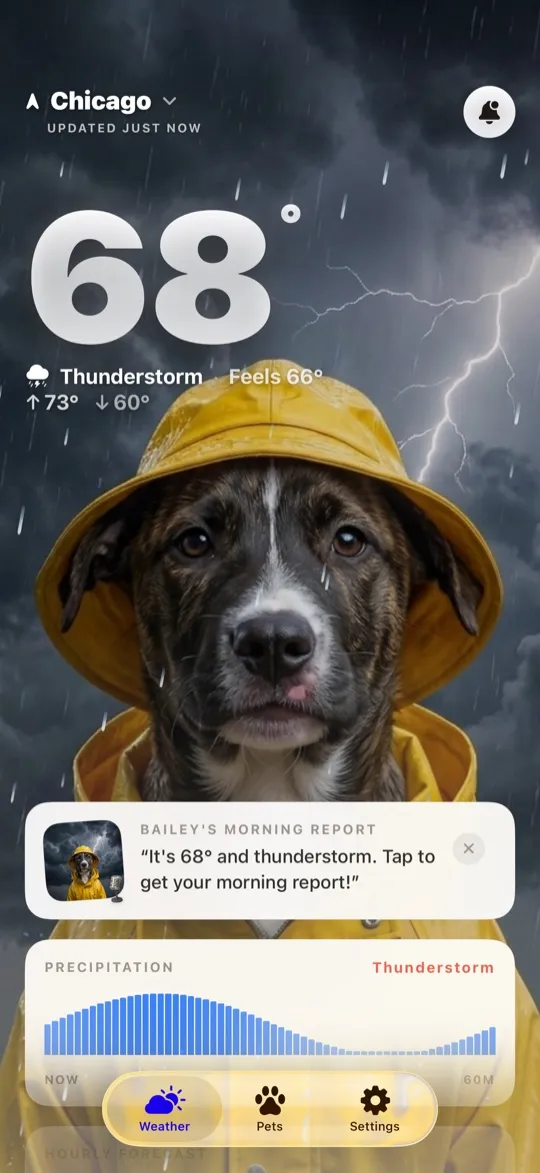
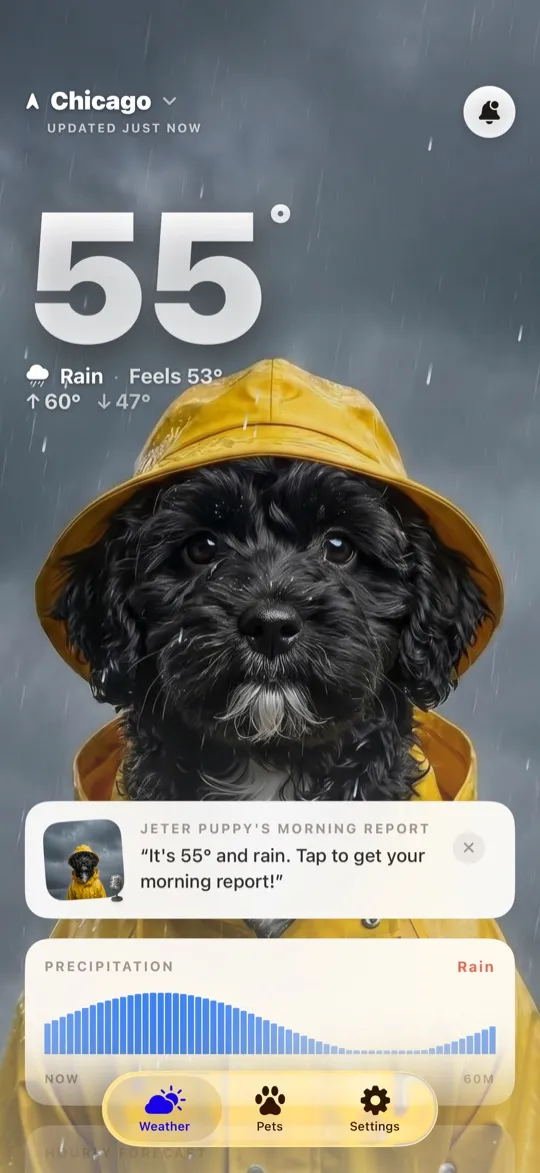
The watch is only useful if you notice it, which is the one part of this a phone is genuinely good at. WeatherPets keeps the day's conditions on your home screen with your own pet delivering them, so severe weather days stop being a surprise you find out about from a siren. Download WeatherPets and pick your pet.
The kit, and the two items people skip
The ASPCA's disaster preparedness guidance is the best single checklist for this, and it recommends seven to ten days of pop-top canned or dry food, water and bowls, medications, a pet first-aid kit and guide, carriers, and recent photos of your pets.
Two of those get skipped almost universally, and both are the ones that matter after the storm rather than during it.
- Recent photos. Not a cute one from three years ago. A clear, current picture of each animal, including any distinguishing markings, stored somewhere that does not depend on your home or your power. This is what you hand to a shelter and post locally if an animal gets out.
- A rescue alert sticker on a front window, which the ASPCA describes as letting people know pets are inside your home. It costs nothing and it speaks for you when you are not there.
Keep the kit in the shelter room itself. A perfect go-bag in the garage is a go-bag you will not have, and the garage is frequently the part of the house that fails first. If you have small pets, remember they need their own version of this; our temperature guide for guinea pigs and rabbits covers how little margin they have once a house stops being climate controlled.

The part nobody plans for is afterwards
Ask anyone who has worked a disaster response and they will tell you the same thing: the animal emergency does not end when the storm does, it starts. Fences come down, gates blow open, screens tear, doors do not latch. And the ASPCA is blunt about the behaviour that follows, noting that pets can become disoriented and wander away from home in a crisis.
So the post-storm rules are simple and worth saying out loud to everyone in the house before the season starts:
- Nobody goes outside off leash. Not for two minutes, not into a fenced yard, not "just to pee".
- You walk the perimeter yourself, in daylight, before you trust any fence again.
- Check tags and microchip registration now, not later. A microchip with a disconnected phone number is a chip that does nothing.
- Watch where they walk. Broken glass, nails, splintered wood and downed lines are all at paw height.
Night warnings are the hard version
A tornado warning at two in the afternoon is a different event to one at two in the morning, and the overnight version is where plans quietly fail. You are asleep, the phone is face down on silent, and the first thing anyone hears is wind.
Ready.gov's advice here is worth taking literally: sign up for your community's warning system, and use the Emergency Alert System and NOAA Weather Radio for emergency alerts. A cheap weather radio in the bedroom is one of the few pieces of household kit that does exactly one job and does it while you are unconscious. If your area is under a watch overnight, that is also the night the carrier goes in the bedroom rather than the hall cupboard, and the night the dog sleeps with a harness on.
None of this takes long. It is an hour in the calm part of the year, and it converts the worst ten minutes of a storm season from improvisation into a checklist. Our full storm and hurricane prep checklist for pets is the wider version if you want to do the whole thing in one sitting.
Frequently asked questions
Where should pets go during a tornado warning?
Wherever you go. The National Weather Service tells people under a tornado warning to move to an interior room on the lowest floor of a sturdy building and avoid windows, and your pets belong in that same room. The difference is that they need to be contained once they are there: a cat in a carrier, a dog in a crate or on a harness and leash you are physically holding, so that nobody bolts when the pressure changes or a window goes.
Should I put my cat in a carrier during a tornado watch or wait for the warning?
During the watch. This is the single most useful change most owners can make. A tornado watch can last hours and is the calm part of the evening; a warning is minutes of noise and hurry, which is exactly when a cat disappears under a bed and becomes uncatchable. Confine at the watch, shelter at the warning. If the watch expires with nothing happening, you have lost nothing.
What if I live in a mobile home and have pets?
Leave before the warning, not during it. The National Weather Service is explicit that people in a mobile home should move to the closest substantial shelter, and moving two cats and a dog takes far longer than moving yourself. That means identifying a nearby sturdy building or community shelter in advance, confirming it takes pets or that your carriers can stay in your vehicle beside it, and going at the watch rather than the warning.
What should be in a pet tornado kit?
The ASPCA recommends seven to ten days of pop-top canned or dry food, water and bowls, medications, a pet first-aid kit, carriers, and recent photographs of your pets. The photos are the item people skip and later need most, because they are what you post and hand to shelters if an animal gets out. Keep leashes, harnesses and a copy of vaccination records with the kit, and store the whole thing in your shelter room rather than the garage.
Why do so many pets get lost after a tornado rather than during one?
Because the containment ends the moment the storm does. Fences, gates, screens and doors are the first things to fail, and the ASPCA notes that pets can become disoriented and wander away from home in a crisis. The practical protection is boring: collars with current tags, a registered microchip with a phone number you still use, and a rule that nobody goes outside off leash until you have walked the perimeter yourself.
Your daily forecast, delivered by your own pet.

A note on health: This article is general information, not a substitute for professional veterinary advice. If your pet is injured during severe weather, shows signs of shock or distress, or you have any serious or emergency health concern, contact your veterinarian or an emergency animal hospital right away. Our guidance draws on trusted veterinary and government sources, including those linked above.
