Why Wind Scares Dogs More Than Thunder Does
Thunder gets all the attention. It is loud, it is obvious, and it is what everybody names when they talk about a storm-scared dog. But plenty of owners will tell you their dog is already pacing an hour before the first rumble, on an evening that never actually storms at all. The trigger they are describing is wind, and almost nobody treats it.
Key takeaways
- Wind attacks the sense dogs trust most. It delivers scent in shifting, contradictory bursts, so the map they navigate by stops making sense.
- It makes the world move. Bins, branches, gates and tarps become unpredictable moving objects, which is genuinely alarming to a dog.
- Wind is often a predictor. If it reliably arrives before storms, a dog learns to react to the wind, which is why the anxiety starts before the thunder.
- Thunder-only desensitisation misses it. Training with bang recordings leaves the first domino standing if wind is what starts the cascade.
- Comforting your dog does not reinforce fear. Punishment does make it worse, and that is the one thing clinical guidance is unanimous on.
The sense you are not thinking about
Start with the thing that makes wind different from every other weather trigger. A dog builds their picture of the immediate world largely out of smell. Who came past, what is in the hedge, whether the neighbour's dog is in the garden, how long ago the fox went through. On a still day that picture is stable and layered and arrives from roughly where the thing actually is.
Wind takes that apart. Scent arrives in gusts from a direction that changes by the second, carrying information from a hundred metres away as though it were close, then dropping it entirely. The dog is not getting less information; they are getting a stream of contradictory information about what might be nearby.
It is worth sitting with how disorienting that is. The nearest human equivalent is not a loud noise. It is being in a room where the lights keep cutting out and voices keep coming from behind you.
And the world will not stay still
The second thing is visual and it is easy to underrate. Dogs are highly attentive to movement, and they are particularly interested in things that move without an obvious reason. On a windy day, objects that have been reliably inanimate for the dog's whole life start behaving like animals: the bin lid lifts, the tarpaulin snaps, the gate bangs, the washing lunges, branches thrash outside the window.
It is not purely a perception problem either. The National Weather Service notes that sustained winds of 40 to 50 mph can cause isolated wind damage, and that high winds blow objects around and pose a genuine threat to safety. The dog reacting to a thrashing garden is not wrong about it.
Add the noise this generates, much of it sudden and irregular, and you have a set of triggers arriving at once. Research on scoring sound sensitivity in dogs catalogues how broad the resulting response can be, from restlessness, panting and an increased startle response through to trembling, hiding, drooling and destructiveness. Most owners recognise several of those from a windy night.

The learned part, which is the important part
Here is why wind so often looks worse than thunder in a given dog, and it is the mechanism most articles skip entirely.
Wind usually arrives first. It builds ahead of a front, it comes with a falling barometer and a darkening sky, and then, sometimes, thunder follows. Writing in Today's Veterinary Practice, the authors list what storm-phobic dogs actually react to, and it is a long list: wind, rain, thunder, lightning, barometric pressure changes, the smell of rain, static electricity, even time of day. They also note a 207 per cent increase in salivary cortisol in dogs after exposure to simulated thunderstorm sounds, and that an estimated 49 per cent of dogs show a significant fear response to firework noise. This is not a fringe problem.
A dog who has been through a few frightening storms does not need to wait for the frightening part. Anything that reliably precedes it will do, and wind is the most obvious candidate. So the dog starts reacting to the build up, and from the outside it looks like an animal terrified of a breeze.
The practical consequence is significant: if you desensitise to thunder only, you may be treating the wrong end of the sequence. Our eight week storm desensitisation protocol is the full version of that work, and the point to carry into it is that whatever starts your dog's cascade is what the protocol has to start with.
There is one more mechanism worth knowing, because it explains dogs who seek out odd places during weather. Speaking to National Geographic, Tufts University's Nicholas Dodman describes how dogs with longer or thicker coats build up static electricity during storms, much as we do before getting a shock off a car door, and how that discomfort can feed a phobia. It is a plausible part of why some dogs head for the bathtub or press against plumbing: those are the places the charge goes away. The same piece notes there is some evidence of genetic predisposition to noise phobia, with border collies and Australian shepherds mentioned, which will not surprise anyone who owns one.
| What your dog is reacting to | Why it lands hard | What you can actually change |
|---|---|---|
| Shifting scent | Their primary sense is giving contradictory answers | Little, directly. Bring them indoors where the air is still |
| Moving objects | Inanimate things behaving unpredictably | Close blinds. Tie down or bring in whatever is moving |
| Irregular noise | Sudden, unpredictable, impossible to localise | Steady background sound. Interior room away from windows |
| Banging hardware | Loud, close and repeating | The easiest win. Latch the gate, secure the bin, fix the fence panel |
| The association | Wind has come to predict a storm | Desensitisation that includes wind, not just thunder |
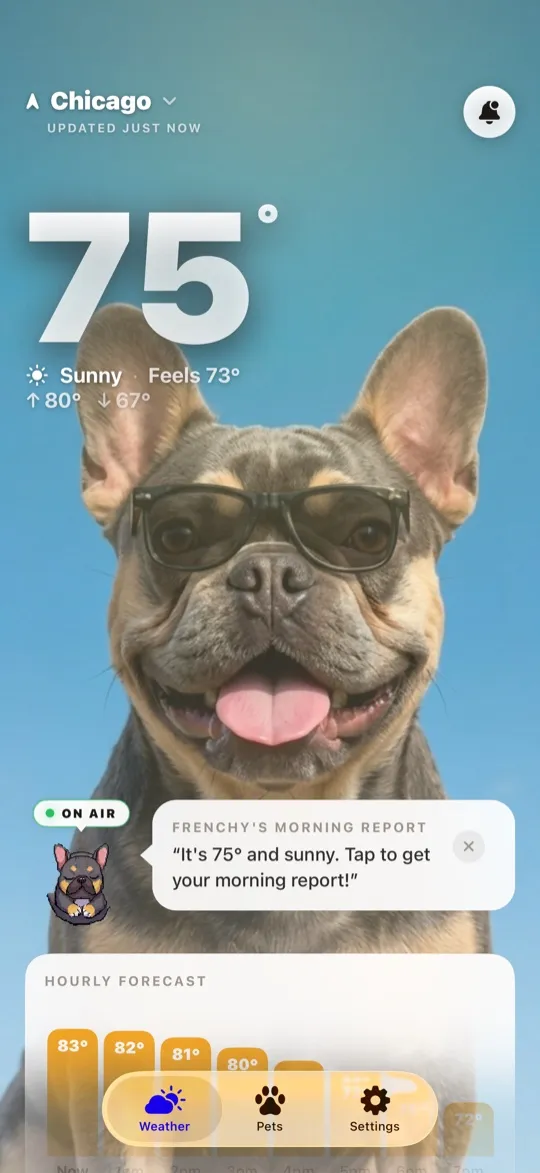
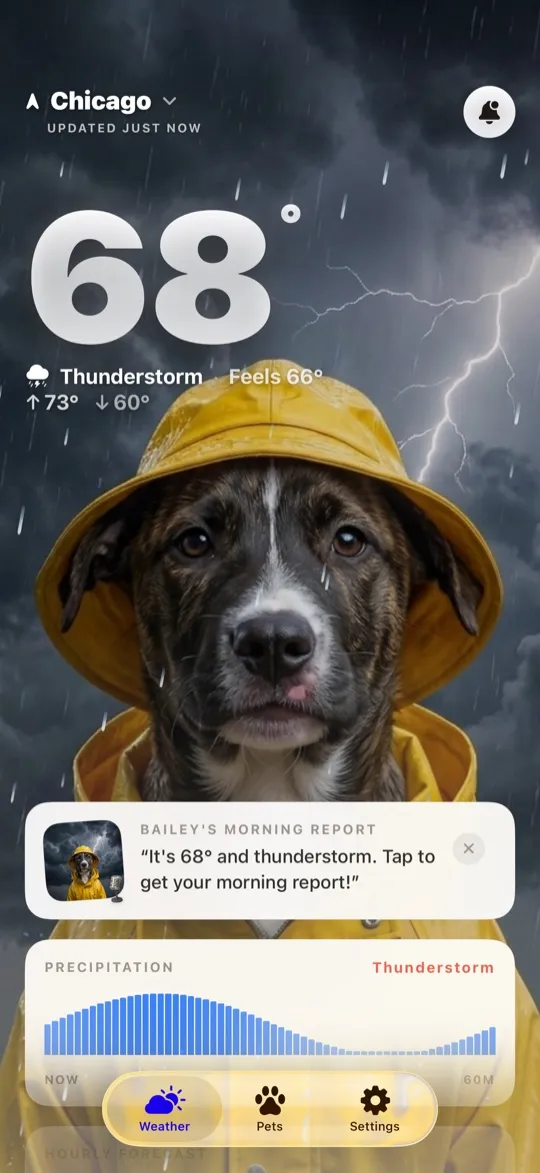
The most useful thing on that table is knowing a windy evening is coming before it starts, because everything here works better done in advance than improvised at nine at night. WeatherPets puts the day's conditions on your home screen with your own pet delivering them, so the gusty evening is on your radar while the garden is still calm. Meet your WeatherPet on the App Store.
What to do on the night
Today's Veterinary Practice sets out the environmental side clearly, and it is refreshingly low tech.
- Bring them indoors. Non-negotiable, and it removes the scent chaos as well as the noise.
- Give them somewhere enclosed. The article specifically mentions a bathtub, a laundry basket or an open closet. Interior rooms with no windows are best, and a covered crate the dog can leave freely works well.
- Add steady background sound. A fan, radio, television or white noise masks the irregular gusts, which is the part that keeps startling them.
- Be there if you can. Owner presence is listed as helping, and it is worth saying plainly that comforting a frightened dog does not reinforce the fear. That old warning has not held up, and it stops people doing the most useful thing available to them.
- Do not punish any of it. The guidance is unambiguous that punishment only increases anxiety and fear. A dog pacing at midnight is not being naughty.
One more, from the practical rather than clinical side: walk before the wind gets up, not during. A dog who is already unsettled does not need a lead walk past thrashing hedges, and our guide to wind chill and dogs covers the separate reason a windy walk costs more than the thermometer suggests.
Training it, not just surviving it
Management gets you through a night. Desensitisation and counterconditioning are what change the dog's mind over a season, and the method is well established: work below the intensity that frightens them, pair it with something excellent, and build up slowly. Today's Veterinary Practice describes short daily sessions of roughly five to ten minutes, starting with the least frightening stimulus and progressing gradually, and pairing the trigger with favourite treats or toys so the dog comes to anticipate something good.
Two adjustments make this work for wind specifically. First, source recordings that actually contain wind rather than thunder claps, and start at a volume the dog barely notices. Second, do the work in the calm months. Trying to desensitise a dog to wind during a week of gales means the real thing keeps overwhelming the training, which sets you backwards. Our guide to prepping an anxious dog before storm season covers that timing question in more depth.
If your dog's response is severe, panic rather than unease, self-injury, destructiveness or refusing to eat for hours, that is a conversation with your vet or a qualified veterinary behaviourist rather than a self-directed project. There is real help available and it works considerably better when it starts early.
The takeaway is narrow but useful. A dog who seems to fear something as harmless as wind is not being irrational. They are responding to a genuine and substantial change in the world as they perceive it, and quite possibly to a reliable warning that something worse used to follow. Both of those are worth taking seriously, and both respond to the same patient work.
Frequently asked questions
Why is my dog scared of wind but not thunder?
Usually because wind is doing more to them than noise. It scrambles scent, which is the sense a dog uses to know what is around them, and it makes inanimate objects move and bang unpredictably. It is also frequently a predictor: if wind reliably arrives before storms where you live, a dog can learn to react to the wind itself, which is why some dogs are visibly anxious an hour before anyone hears thunder.
Can dogs really sense a storm coming?
They can detect a great deal about what is happening right now, which is not the same as forecasting. Clinical writing on storm phobia lists barometric pressure changes, the smell of rain, static electricity, wind and even time of day among the stimuli dogs respond to. So a dog reacting before you notice anything is picking up real, present signals rather than predicting the future. The practical consequence is that the reaction often starts well before the part you were planning to manage.
Does treating thunder fear help with wind fear?
Partly, and the gap is the problem. Most desensitisation work uses storm recordings that focus on thunder, so a dog can end up much better with the bang and no better at all with the build up. If wind is what starts your dog's cascade, wind is what the training has to include, at low volume first and paired with something they love. Otherwise you have treated the second domino and left the first one standing.
What should I do during a windy night?
Bring them in, give them somewhere enclosed to be, and add steady background sound. Behaviour guidance for storm phobia recommends an interior safe place such as an open closet, a bathtub or a covered crate, background noise from a fan, radio or television, and the owner being present if possible. Shut blinds so moving shadows and swaying branches stop being visible, and secure whatever is banging outside, because a loose gate is a trigger you can simply remove.
Will comforting my dog make the fear worse?
No. This is an old idea that has not held up, and it stops people doing the one thing that helps most. You cannot reinforce an emotion the way you reinforce a behaviour, and clinical guidance is clear that punishment increases anxiety. If your dog wants to be near you during wind, let them. What genuinely makes it worse is forcing them to stay outside or to face the thing they are frightened of at full intensity.
Your daily forecast, delivered by your own pet.






A note on health: This article is general information, not a substitute for professional veterinary advice. If your dog panics, injures themselves, or cannot settle during storms or wind, contact your veterinarian or a qualified veterinary behaviourist. Our guidance draws on trusted veterinary sources, including those linked above.
