Back-to-School Separation Anxiety in Pets: A 4-Week Plan
For ten weeks your pet has had company almost every waking hour. Then one Tuesday in September everyone leaves at 7:40am and the house goes silent until four. That abrupt change is the single most predictable behaviour trigger of the year, and it is also the most preventable, because you can see it coming on a calendar. Here is how to tell genuine separation distress from boredom, what it looks like in cats as well as dogs, and a four-week plan you can start now.
Key takeaways
- Start before the first bell. Departure training needs weeks, and it works best when your pet is not already failing every day.
- Timing tells you what it is. Real distress starts within 15 to 30 minutes of you leaving. Damage two hours later is usually boredom.
- A panicking pet will not eat. An untouched puzzle toy is one of the most useful diagnostics you have.
- Cats get it too. A study of 223 cats found 13.45 percent showed at least one separation-related sign.
- Punishment makes it worse. This is panic, not disobedience, and it does not respond to correction.
Why the first week of school is so hard on pets
Pets do not track dates, they track patterns. Over a summer, a pet builds a model of the day where someone is nearly always around, the door opens constantly, and being alone lasts twenty minutes at most. Then the pattern breaks in a single morning and stays broken for eight hours a day, five days a week.
The Colorado State University Veterinary Teaching Hospital flags this transition specifically, and the American Veterinary Medical Association covered the same mechanism when households went back to work after a long period at home. The AVMA puts separation anxiety at roughly 14 to 20 percent of the dog population, which makes it one of the most common behaviour problems there is.
The mistake almost everyone makes is switching over on day one. The house goes from full to empty with no warning and no practice. Everything below is really just a way of making that change gradual instead of sudden.

Separation anxiety, isolation distress, or plain boredom?
This is the part most advice skips, and getting it wrong wastes months. Researchers led by Daniel Mills at the University of Lincoln analysed 762 dogs and found that what we lump together as separation anxiety is not one condition but at least four different problems, including frustration focused on the exit, reactions to things happening outside, and straightforward boredom. As Mills has put it, separation anxiety is better understood as a sign than as a diagnosis.
That matters practically, because the four look similar from the outside and need different responses. Here is how to sort yours.
The 30-minute rule
Genuine separation distress starts fast, usually within 15 to 30 minutes of the door closing and often within 10. If your camera shows a dog that settled, slept for an hour and then got up and shredded a cushion, that is understimulation, not panic.
Look at what got destroyed, and where
Distressed pets attack exits. Door frames, the carpet in front of the door, window sills, blinds, crate bars. A bored pet goes for whatever is interesting: shoes, the bin, the arm of the sofa. The location of the damage is often more informative than the amount.
The untouched food test
An animal in genuine panic will not eat. Leave a stuffed puzzle toy and check it on camera. If it is empty, that points away from panic. If it sits untouched for an hour while your dog paces, that is real distress. This one test costs nothing and settles most arguments.
Isolation distress is a different thing again
Some pets are not missing one specific person, they simply cannot cope with being alone. The difference is practical rather than academic: if a sitter, a neighbour or daycare completely solves the problem, that is isolation distress. If your pet is bonded to one person and no substitute helps, that is true separation anxiety, and you need the training below.
Before any of this, rule out the boring explanations. The ASPCA lists medical causes worth excluding first, including urinary tract infections, incontinence, diabetes and kidney disease, along with behavioural ones like incomplete house training, urine marking and normal adolescent chewing. A vet visit before a training plan is rarely wasted.
| What you see on camera | Points to boredom | Points to separation distress |
|---|---|---|
| When it starts | An hour or more in, often after a nap | Within 15 to 30 minutes of you leaving |
| Where the damage is | Objects: shoes, bins, cushions | Exits: doors, frames, blinds, crate bars |
| The puzzle toy | Emptied | Untouched |
| Body language | Relaxed, then busy | Drooling, panting, trembling, fixed pacing route |
| Happens when you are home? | Sometimes, if under-exercised | Almost never |
| Does a sitter fix it? | Yes | Only if it is isolation distress |
What it looks like in cats, and why it gets missed
Cats are the blind spot in almost every article on this subject, which is strange, because the evidence is good. A study of 223 cats published in PLOS ONE (PubMed) found 30 of them, 13.45 percent, showed at least one sign of a separation-related problem. Among those cats, destructive behaviour appeared in 66.67 percent, excessive vocalisation in 63.33 percent, and urinating outside the box in 60 percent.
The Indoor Pet Initiative at Ohio State's College of Veterinary Medicine adds the signs owners tend to misread: refusing food or water while you are out, vomiting that often contains food or hair, overgrooming to the point of bald patches, eliminating on the owner's clothes or bed specifically, and an over-the-top greeting when you get back.
The reason it gets missed is that cat distress is quiet and gets filed under something else. Peeing on the bed reads as spite or a litter box preference. Overgrooming reads as allergies. A cat that stops eating while you are gone but eats when you are home looks like a fussy eater. Point a camera at your cat for a couple of mornings and you will learn more than a month of guessing.

The four-week plan: start before the first bell
One rule underpins everything, and it is the sentence that almost every back-to-school article leaves out. The ASPCA is blunt about it: while you are doing this training, your pet should not be left alone except during the practice sessions. Every unplanned panic session undoes progress. That is precisely why you start in early August rather than the night before school, and why a sitter, a neighbour or daycare for a couple of weeks is a genuine part of the plan rather than a luxury.
The training itself is unglamorous. You are teaching your pet that departures are boring and that you always come back, in doses small enough that panic never starts.
| Week | What you practise | Target time alone | Back up a step if |
|---|---|---|---|
| Week 1 | Break the departure cues. Pick up keys and put them down. Put shoes on, sit and read. Touch the door handle and walk away. Many short reps a day. | Zero. This is all cue work. | Your pet still gets up and follows every single time. |
| Week 2 | Step behind an interior door for 1 to 2 seconds, then come back with no fuss. Build up second by second. | Up to about 60 seconds | Any whining, pacing or scratching. Drop back to the last easy duration. |
| Week 3 | Move to the front door, with keys and shoes, exactly like a real departure. Build 1 minute to 5 to 15. | About 15 minutes | Distress inside the first 5 minutes. |
| Week 4 | Push through the 40-minute wall, where most of the distress lives. Then extend in 5-minute jumps, later 15. | 40 minutes and beyond | Any regression. Repeat the last duration that went well. |
Keep departures and returns deliberately dull. No emotional goodbye, no big reunion. You are trying to make your leaving the least interesting event of the day. Be realistic about the timeline too: trainers generally report mild cases improving in four to six weeks, moderate cases taking two to three months, and severe cases six months or more. Four weeks gets many pets to a workable place before term starts, not to a finished one.
What actually helps, and what the evidence says
Food puzzles do real work
This is the best-supported piece of enrichment available, especially for cats. A review in the Journal of Feline Medicine and Surgery by Dantas and colleagues documented food puzzles reducing stress signs, decreasing reactivity, easing anxiety and fear, and resolving attention-seeking behaviour and inappropriate toileting. Feed at least one meal a day out of a puzzle rather than a bowl, for cats as well as dogs. It doubles as your diagnostic.
The TV and radio question, answered honestly
Everyone repeats this advice. The evidence is thinner than you would think. Researchers at Queen's University Belfast, writing in Applied Animal Behaviour Science in 2022, tested 82 pet dogs separated from their owners with classical music and with an audiobook, and found only a moderately calming effect from the music and no welfare benefit from the audiobook. The older studies that made this advice famous were run in rescue kennels, which are loud, chronically stressful places, and that does not transfer neatly to a quiet living room. Leave something on to mask street noise if you like. Do not expect it to treat anxiety.
A camera is the cheapest useful thing you can buy
Veterinary behaviourists quoted by the AVMA recommend webcams for exactly this. Record the first 30 to 60 minutes after you leave. That footage tells you whether this is panic or boredom, whether to move up a step or back one, and whether the plan is working at all. Without it you are guessing.
An anchored morning routine
Predictability is the actual treatment, and the most reliable anchor is a real walk or play session before the house empties. Which brings us to the thing most likely to quietly wreck a four-week plan.
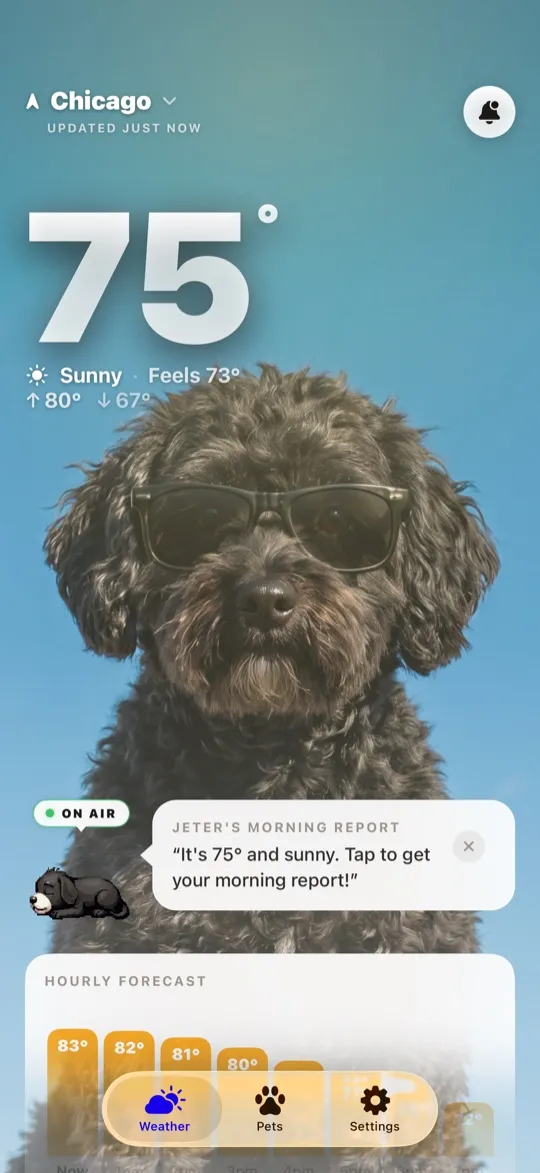
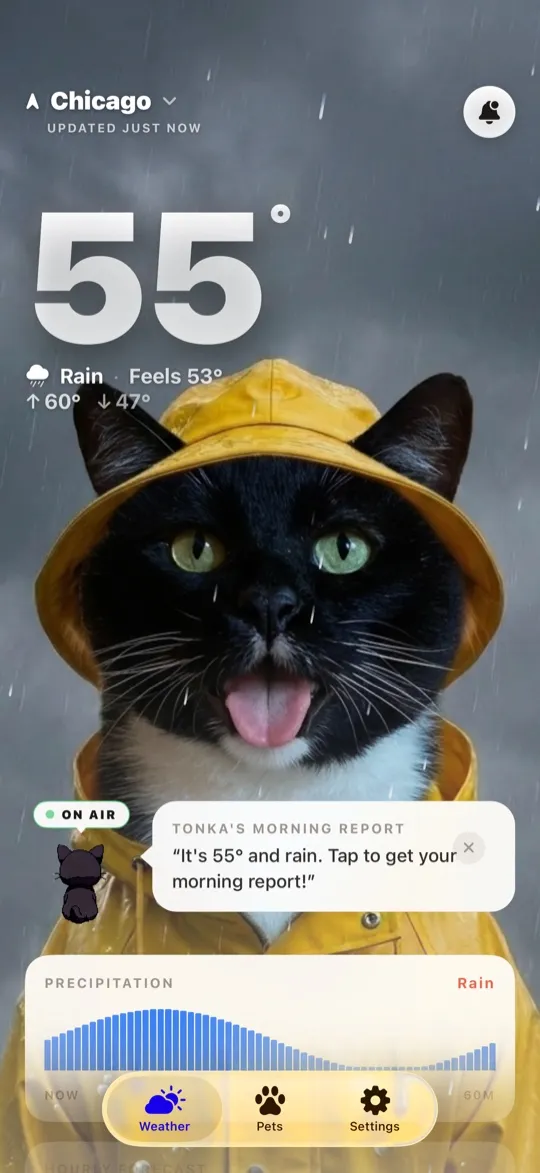
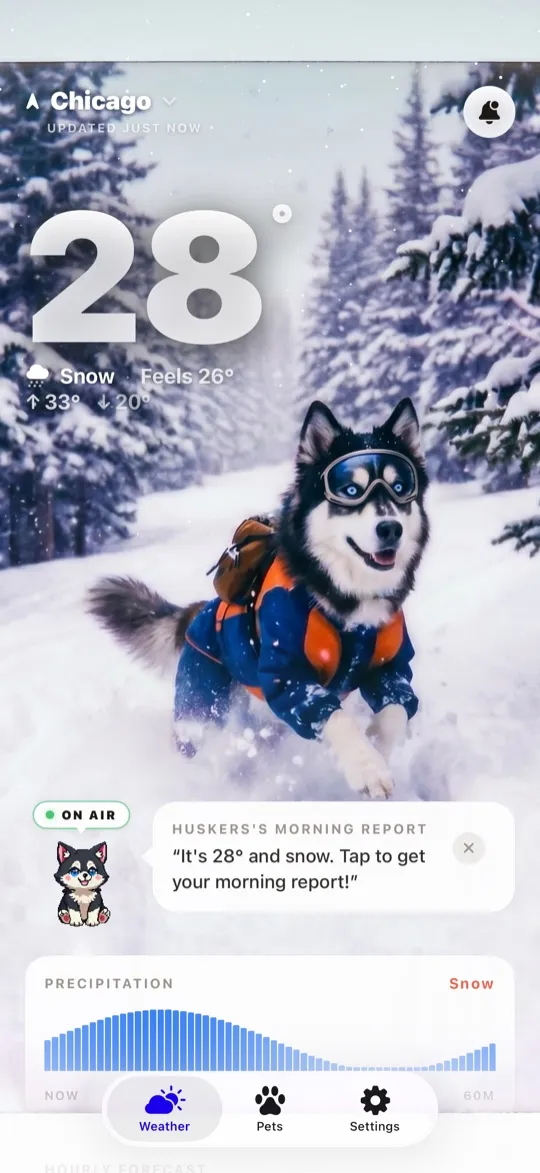
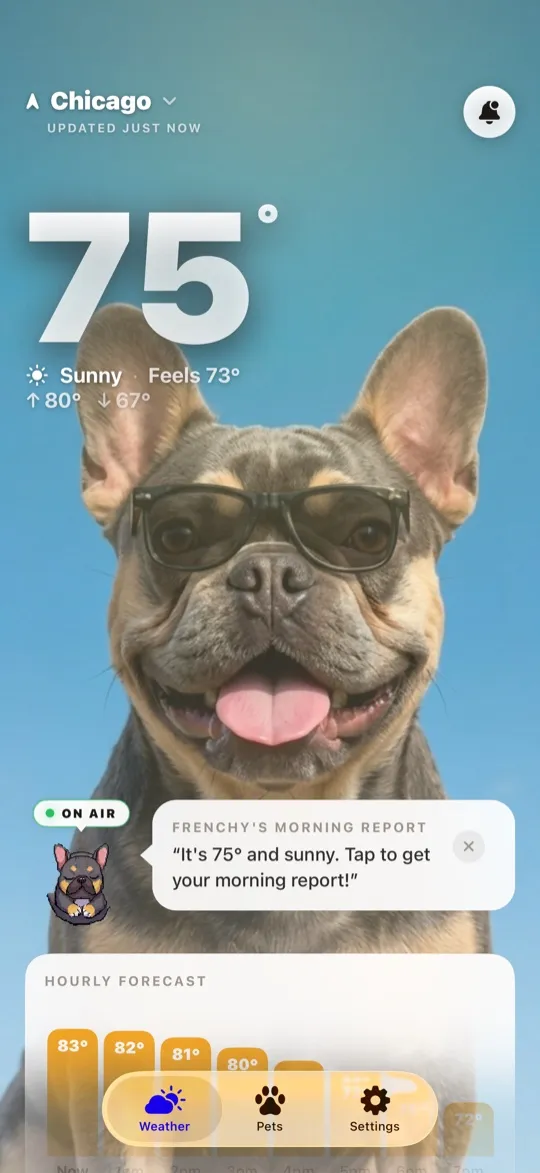
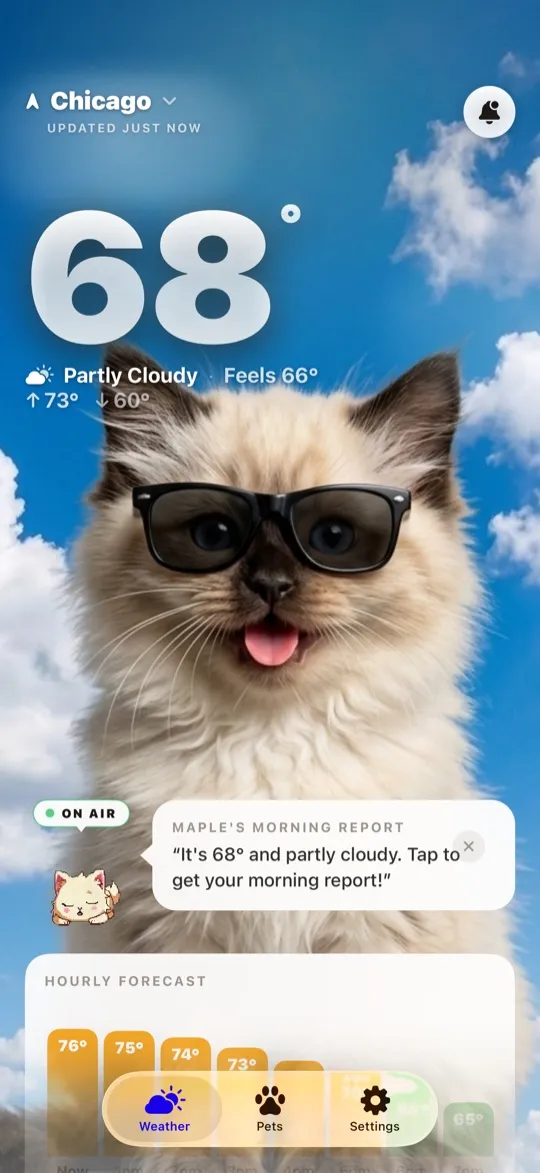
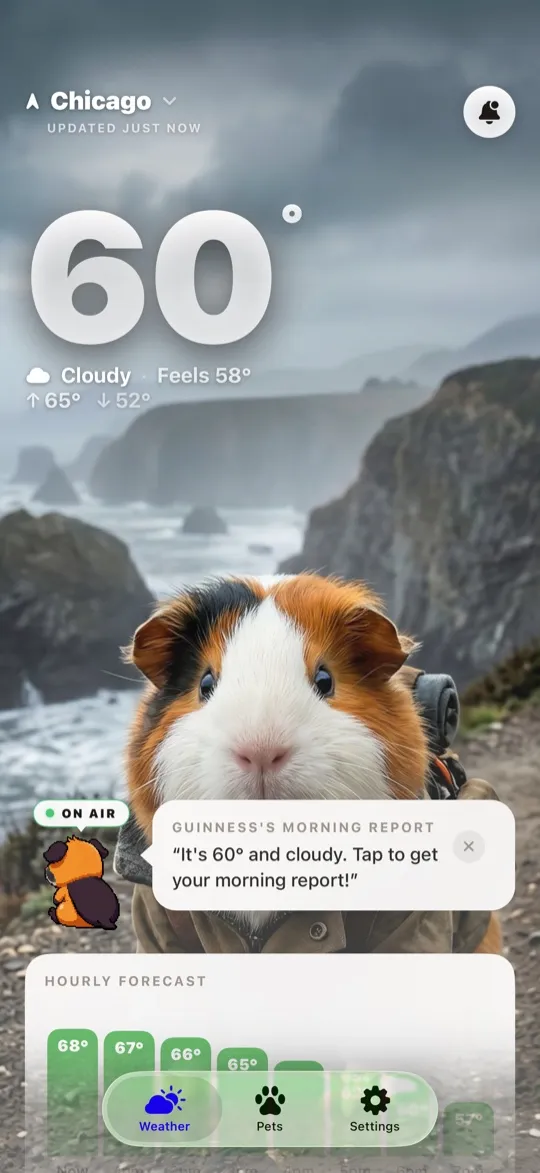
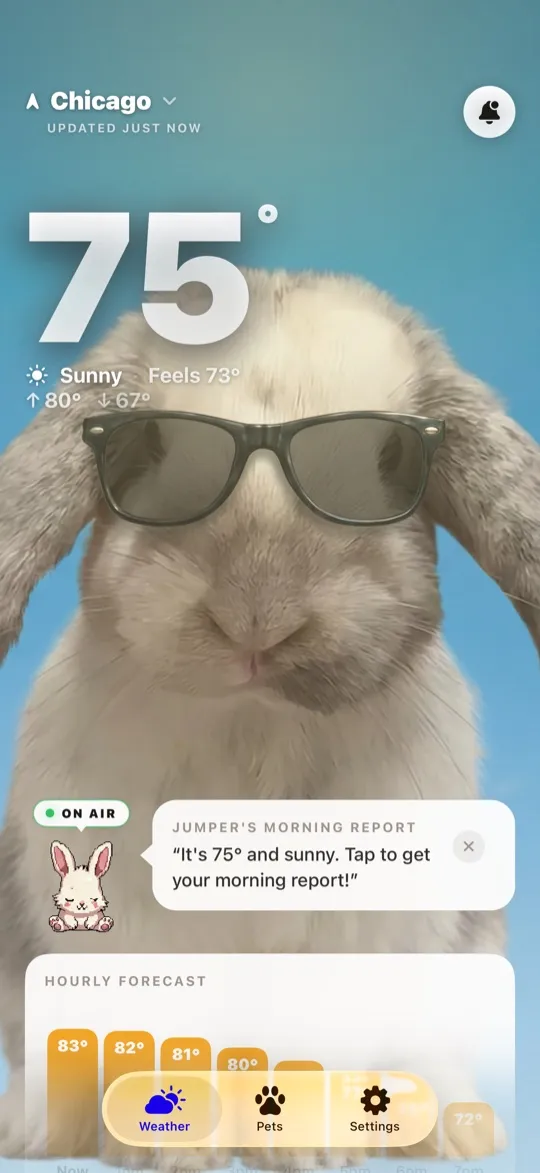
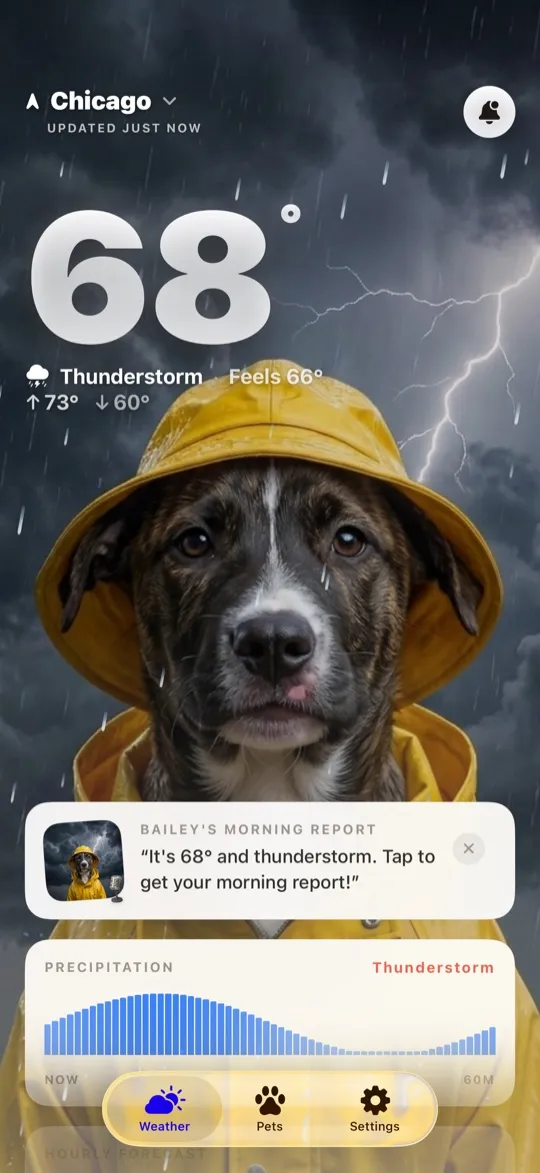
Weather is the biggest uncontrolled variable in a morning routine, and it matters more than owners realise. A study of 3,153 owners in the journal Animals found people were 48.2 percent less likely to walk their dog in the cold and 25.3 percent less likely in rain, and in heat 81.7 percent reported shortening the walk. A routine that silently erodes over six weeks of bad mornings takes the training with it. Checking tomorrow's window tonight is how you decide whether the walk happens at 6:30 or becomes a fifteen-minute foraging game indoors. Meet your WeatherPet on the App Store.
The practical version of that: anchor the routine to events rather than to the walk. Breakfast, then puzzle, then the departure ritual, in that order, every day. If the weather cancels the walk, the other three still happen and the day still looks the same to your pet. That is what makes a routine weather-proof, and it is genuinely the most useful thing in this article. Our guide to adjusting your walk schedule by weather goes deeper, and indoor exercise for dogs covers the wet-morning substitutes.
What does not work, and what makes it worse
- Punishment. Coming home to a mess and telling your dog off does nothing except add fear to an already frightened animal. These are distress responses, not disobedience. The American Veterinary Society of Animal Behavior is explicit that training should be reward-based, and that aversive methods risk increased fear and aggression.
- Getting a second pet. The problem is your absence, and another animal does not stand in for you. You can end up managing two anxious animals instead of one.
- Crating a panicking dog. Fine for a dog that loves its crate, actively harmful for one that does not. Watch for heavy panting, drooling, frantic escape attempts and persistent howling, and use a gated room instead if you see them. Dogs genuinely injure themselves trying to get out.
- Exercise alone. A tired dog is easier to live with, and exercise fixes the boredom cluster completely. It does very little for genuine exit frustration. Necessary, not sufficient.
- Switching cold turkey on day one. The entire point of starting in August.
When to involve your vet
Some cases need more than training, and there is no virtue in waiting it out. Talk to your vet if the distress is severe enough that you cannot even begin the training, if there is self-injury or damage from escape attempts, or if six to eight consistent weeks produce no progress at all.
Two medications are FDA approved for separation anxiety in dogs: clomipramine and fluoxetine. Clomipramine can take four to six weeks to reach its full effect, so it is not a night-before fix. Medication is always used alongside behaviour work rather than instead of it, and the AVMA notes that roughly 15 percent of dogs do not respond to medication and a similar share do not respond to behavioural treatment alone. If you are getting nowhere, ask for a referral to a veterinary behaviourist.
One last note on scope: if the trigger turns out to be noise rather than absence, thunder, fireworks or bin lorries, that is a different problem with different answers. We covered it in dogs and thunderstorm anxiety.
Frequently asked questions
How do I know if my dog has separation anxiety?
Point a camera at the room and watch the first 30 to 60 minutes after you leave. Genuine separation distress usually starts within the first 15 to 30 minutes, often sooner, and comes with autonomic signs you cannot fake: drooling, heavy panting, trembling, pacing a fixed route. Damage that happens two hours in, after a nap, is a different problem.
What is the difference between separation anxiety and boredom in dogs?
Three tells. Timing: distress starts almost immediately, boredom builds later. Target: a distressed dog destroys exits such as doors, window frames and crate bars, a bored dog destroys interesting objects such as shoes and bins. Food: a panicking dog will not eat, so an untouched stuffed puzzle toy is meaningful evidence of real distress, and an empty one points away from it.
Can dogs grow out of separation anxiety?
Not usually on their own, and waiting tends to make it worse because every bad departure rehearses the panic. It responds well to gradual departure training. Trainers generally report mild cases improving in four to six weeks, moderate cases in two to three months, and severe cases taking six months or more.
Is it cruel to crate a dog with separation anxiety?
It depends entirely on the dog. A dog that genuinely likes its crate is fine. For a panicking dog, a crate can make things worse and carries a real injury risk from escape attempts. The ASPCA flags heavy panting, excessive salivation, frantic escape attempts and persistent howling as signs the crate is not helping. Try a room with a baby gate instead.
Will getting a second dog help with separation anxiety?
Usually not. The distress is about your absence specifically, and another animal does not substitute for the person the dog is bonded to. You can end up with two anxious pets. There is an exception worth knowing: if your pet is distressed simply by being alone rather than by missing one particular person, company genuinely does help, and a sitter or daycare can solve it.
Do cats get separation anxiety?
Yes, and it is badly under-recognised. A study of 223 cats published in PLOS ONE found 13.45 percent showed at least one sign of a separation-related problem. The most common were destructive behaviour, excessive vocalisation and urinating outside the litter box. Cats tend to express distress quietly, so it often gets read as spite or a litter box problem.
Should I leave the TV or radio on for my dog?
It is fine, but do not expect much. Researchers at Queen's University Belfast, in a 2022 study, tested 82 pet dogs with classical music and with an audiobook and found only a moderate calming effect from music and no welfare benefit from the audiobook. Masking street noise is a reasonable reason to leave something on. Calming a genuinely anxious dog is not what it does.
When should I talk to my vet about anxiety medication?
When the distress is severe enough that you cannot start training, when there is self-injury or escape attempts causing damage, or when six to eight consistent weeks bring no progress. Two medications are FDA approved for canine separation anxiety, clomipramine and fluoxetine, and clomipramine can take four to six weeks to show its full effect. Medication is used alongside behaviour work, never instead of it.
Your daily forecast, delivered by your own pet.



A note on health: This guide is general information built on published veterinary and behavioural research, not veterinary advice, and it cannot account for everything about an individual animal. Separation distress can look like several medical problems, so please rule those out with your veterinarian first, and speak to them or a veterinary behaviourist before starting any medication or if your pet is injuring itself. Our guidance draws on trusted sources, including those linked above.