Can Dogs Swim? The Myth That Puts Dogs in Danger Every Summer
Almost every dog will move its legs when it hits water. That is where the myth starts, because owners see paddling and assume swimming. They are not the same thing, and the gap between them is where dogs get hurt. Here is which dogs genuinely cannot swim and why, the water temperature rule you can work out from a forecast, how to spot a dog in trouble, and the two opposite water emergencies that can both land on the same hot afternoon.
Key takeaways
- Paddling is not swimming. The leg motion is a reflex. Staying level, making progress and getting out again are learned skills.
- Three body types genuinely struggle: flat faces, long bodies on short legs, and barrel chests with heavy heads.
- Do the arithmetic before you go. Air temperature plus water temperature should total at least 100°F.
- Too much fresh water and too much salt water are both emergencies, and they look almost identical from the outside.
- Most pool trouble is an exit problem. Dogs swim to the nearest wall, not to the steps.
The short answer: most dogs can paddle, but paddling is not swimming
Drop almost any mammal in water and the legs start moving. It is a reflex, not a plan. What we call swimming is something else entirely: keeping the spine roughly level, keeping the nose clear without craning, moving forward with some efficiency, and knowing how to get out at the end. Those are skills, and a dog that has never been taught them is improvising in an environment where mistakes are expensive.
This matters because of what a struggling dog does. As it tires, the back end sinks and the body rotates toward vertical. The front paws start slapping at the surface. From the shore it can look like enthusiasm. It is the opposite. The sentence that most often comes right before an emergency is "she will figure it out."
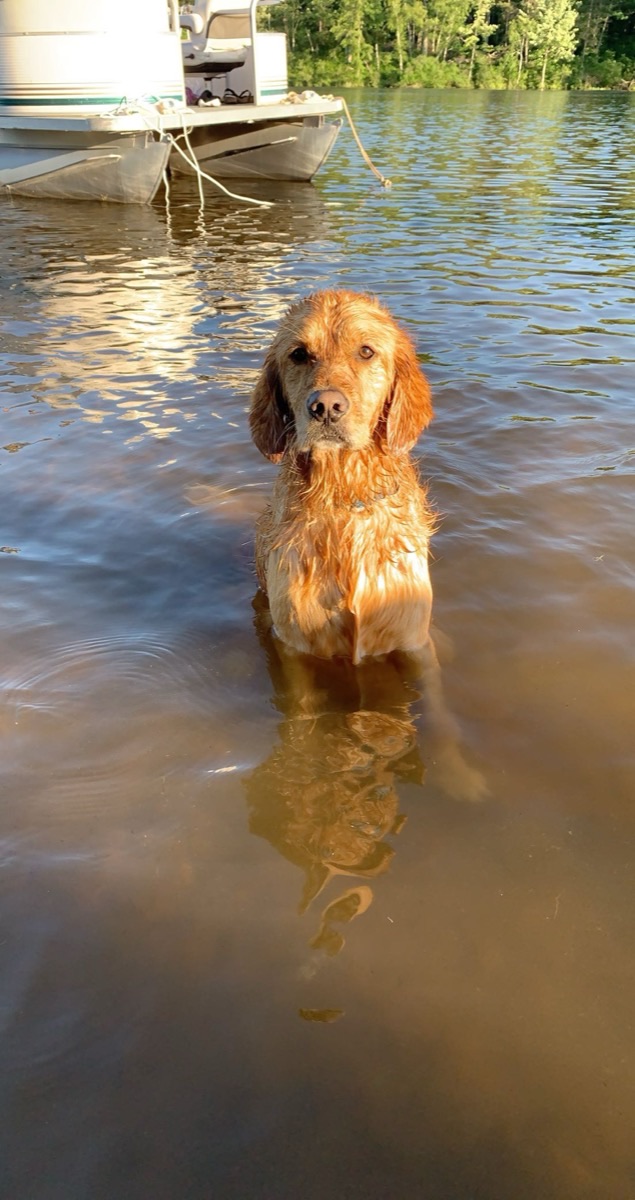
The three body types that genuinely cannot swim
Breed lists float around the internet without ever explaining the mechanism, which makes them impossible to apply to a mixed breed. The useful version is anatomical. Three body plans fight the water, and if your dog has one of them you already know which.
Flat faces
Pugs, French and English bulldogs, boxers, shih tzus and Pekingese all carry a shortened muzzle. To keep the nostrils clear of the surface, the dog has to tilt its head upward, and tilting the head up rotates the hindquarters down. The dog effectively sinks by the stern while trying to breathe. Add an airway that is already compromised, and a short swim becomes hard work fast. If this is your dog, our guide to flat-faced breeds and heat risk covers the same airway problem on land.
Long bodies on short legs
Dachshunds, both corgi varieties and basset hounds have the weight of a long torso and very little leg to move it with. They can rarely hold a horizontal line, and they tire quickly. Bassets add heavy pendulous ears that trap water and a notably heavy head.
Barrel chests and heavy heads
Bull terriers, bulldogs and some boxers carry dense muscle and a large head relative to their buoyancy. They float low, and low is the wrong place to start. Worth noting these are not the same as deep-chested dogs, where the concern is bloat rather than flotation.
One more factor cuts across all three: coat. A long or thick double coat waterlogs, adds real weight, and can fall across the face.
| Breed | Body type | Why water is hard | Safe in water? |
|---|---|---|---|
| Labrador, Golden Retriever, Newfoundland, Portuguese Water Dog | Built for it: level body, webbed feet, water-shedding coat | Nothing working against them | Strong swimmer, still supervise |
| Standard Poodle, German Shepherd | Athletic, balanced frame | Capable, but stamina varies a lot by individual | Usually fine, vest for open water |
| Boxer, Bull Terrier | Barrel chest, heavy head | Dense muscle floats poorly, sits low | Vest, supervised, shallow |
| Corgi, Dachshund, Basset Hound | Long body, short legs | Not enough propulsion for the load, tires fast | Vest, supervised, shallow |
| Pug, French Bulldog, English Bulldog, Shih Tzu, Pekingese | Flat faced | Head tilts up to breathe, which sinks the rear | Vest always, shallow only, within arm's reach |
How to tell a dog is in trouble in the water
Drowning is quiet. People expect thrashing and noise, but a dog in real difficulty is spending everything it has on breathing, so it usually cannot bark. Watch for a body that has gone vertical instead of horizontal, a head tilted back, front paws slapping at the surface as if climbing an invisible ladder, frantic movement with no forward progress, and a head that keeps dipping under and coming back. Some dogs go still and quiet instead. Silence near water is a reason to look harder, not to relax.
About "dry drowning": what the term gets wrong
You will find dry drowning and secondary drowning repeated on almost every pet water safety page. The terms have actually been retired. Drowning authorities including the American Red Cross have retired them, because reviews of the evidence found no support for these as distinct conditions and concluded the labels create unnecessary fear and can lead to poor diagnosis. Public health guidance now uses a single definition of drowning, which you can see in the CDC's drowning overview. In veterinary settings the language is near drowning or submersion syndrome.
Retiring the label does not retire the concern. Water that reaches the lungs can cause trouble that shows up later. After any near miss, watch your dog for the rest of the day for coughing, fast or laboured breathing, unusual lethargy, or gums that look pale or blue tinged, and call your vet if any of it appears. The right takeaway is not "relax, dry drowning is a myth." It is "the scary name was wrong, the vigilance is still right."
Two opposite emergencies from the same afternoon
This is the part almost nobody explains, and it is genuinely elegant once you see it. A dog can get into serious trouble from drinking too much fresh water or too much sea water, and the two are mirror images.
Water intoxication
A dog that spends an afternoon retrieving a ball from a lake swallows water on every trip. Cornell's Riney Canine Health Center describes how that dilutes blood sodium, pulls water into cells including in the brain, and can cause seizures and worse. Signs include staggering or loss of coordination, lethargy, a bloated look, vomiting, glazed eyes and tremors. It can move fast.
Salt toxicity
At the beach the opposite happens. The Merck Veterinary Manual notes seawater is roughly 3.5 percent sodium and records dogs developing hypernatremia after swimming or playing in the ocean without access to fresh water. Excess sodium pulls water out of brain cells instead. Vomiting comes first, then weakness, diarrhoea, tremors and seizures.
Both present as a wobbly, tremoring dog. Both are largely prevented by the same two boring habits: a bowl of fresh water available the whole time, and real breaks out of the water. Cornell recommends frequent half-hour breaks across a day at the water.
| Emergency | Trigger | What is happening | Early signs | Prevention |
|---|---|---|---|---|
| Water intoxication | Repeated retrieving in fresh water | Blood sodium is diluted, cells swell | Staggering, bloating, glazed eyes, vomiting | Half-hour breaks, flat toys instead of balls, shorter sessions |
| Salt toxicity | Swallowing sea water without fresh water available | Blood sodium spikes, cells shrink | Vomiting first, then weakness and tremors | Fresh water bowl on the sand, offer it often |
| Limber tail | Hard swimming, often in cold water | Strain to the tail muscles | Limp tail, or held out and then dropped | Warm-enough water, shorter sessions |
That last one is worth naming because owners panic when they see it. Limber tail, properly acute caudal myopathy, shows up within about a day of hard activity or a cold swim. The tail hangs limp, or sticks out a few inches and then drops. It is painful but usually settles within about a week, and it is most common in retrievers, pointers, setters and hounds.
Where you swim changes the risk
Pools
The chlorine is mostly a non-issue once diluted. The pool shed is not: the ASPCA warns that undiluted algicide, chlorine tablets and pool shock are corrosive and can cause severe ulcers in the mouth, throat and esophagus. Lock them up.
The bigger pool risk is architectural. A dog in a pool swims to the nearest wall, because that is where the edge is, and a pool wall is a smooth vertical surface with nothing to climb. Dogs cannot use pool ladders. A dog that cannot find the exit swims the perimeter until it is exhausted. Fit a wide ramp or dog-friendly steps, then actually rehearse it: lead your dog to the exit on a leash from several different points in the pool until going there is automatic.
Lakes and ponds
Still, warm, sunlit water is exactly what blue-green algae likes, and some blooms are lethal within hours. We covered that in detail in blue-green algae and dogs, including the weather pattern that builds a bloom. If the water looks like pea soup or has a paint-like scum, keep everyone out.
Ocean
Beyond the salt, Cornell's beach guidance flags currents, jellyfish (including dead ones washed up), and sand ingestion, which can cause a serious blockage. Rinse the salt and sand off afterwards and dry the ears.
The single most cited water safety rule in this whole topic is a weather calculation, and the air temperature half of it is already on your phone every morning. WeatherPets puts the day's high in front of you, delivered by your own dog, so the swim-or-wade decision takes about three seconds. Meet your WeatherPet on the App Store.
Life jackets are not just for dogs who cannot swim
The American Veterinary Medical Association recommends a properly fitting flotation device at all times in and around water, and it says so explicitly even for pets who know how to swim. The reason is mechanical rather than sentimental. A good vest holds the back level, and a level back is what lets a dog paddle with all four legs properly instead of rotating upright and treading with the front two.
Fitting one properly takes three measurements:
- Girth, around the widest part of the chest just behind the front legs. This is the measurement that carries the load, so trust it over the weight range on the label.
- Length, from the base of the neck to the base of the tail.
- Neck, measured where a collar would sit.
With the vest on and the dog standing naturally, you want two fingers between the vest and the dog: snug enough that it cannot slide over the head, loose enough to breathe. Look for a grab handle rated to lift your dog's full weight, bright colour with reflective trim, and adjustable straps. If your dog is between sizes, size up.

How cold is too cold, and how long is too long
The most useful threshold in this whole subject is arithmetic you can do from a forecast. The American Kennel Club suggests adding the air temperature to the water temperature and looking for at least 100°F combined. An 80 degree day over 55 degree water is 135, and fine. A 62 degree day over 55 degree water is 117, and marginal for a small or thin-coated dog. This rule earns its keep in May and September, when the air feels swimmable long before the water catches up.
On duration, the AKC suggests short sessions of around 10 minutes, and Cornell suggests half-hour breaks out of the water through the day. Swimming is much harder work than it looks. The widely circulated numbers claiming exact minute limits by age and breed do not trace back to veterinary sources, so treat those two guidelines as the floor and your own eyes as the rest. When the tail stops wagging and the paddle gets sloppy, the swim is over.
Do not forget the dry half of the day either. Cornell notes that once it reaches about 85°F, or lower with high humidity, outdoor time should be limited, and a dog at the beach is standing on hot sand between swims. Our guides to summer hydration and the 7-second pavement test cover that side.
Teaching a nervous dog, the right way
Never throw a dog in. It is the fastest way to create a permanent fear of water, and it teaches nothing. Start in a paddling pool or ankle-deep water at a gently sloping shore, never a pool wall. Put the vest on from the very first session so the dog never experiences sinking. Go in with them. Keep sessions short and end while they are still enjoying it.
Teach the exit before you teach the swim. A dog that knows exactly where the ramp or the shallow end is has a way out when it gets tired, and that single piece of training prevents most of the genuinely bad outcomes. For older dogs or dogs with joint problems, swimming can be excellent low-impact exercise, but check with your vet first and keep it brief.
Frequently asked questions
Do all dogs know how to swim instinctively?
No. Most dogs will paddle if they end up in water, but paddling is a panic reflex, not swimming. Real swimming means holding the body level and making forward progress without exhausting itself. Plenty of dogs paddle furiously, go vertical, and sink. Treat swimming as a skill you teach, not an instinct you assume.
What dog breeds cannot swim?
Three body types struggle badly. Flat-faced breeds such as pugs, French bulldogs and English bulldogs have to tilt the head up to keep the nose clear, which drops the rear end. Long-bodied, short-legged dogs such as dachshunds, corgis and basset hounds cannot get enough propulsion for the weight they carry. Barrel-chested, heavy-headed dogs such as bull terriers and boxers sit low in the water. Any of these can be in water safely, but only in a life jacket, in shallow water, with someone within arm's reach.
How cold is too cold for a dog to swim?
The American Kennel Club suggests a simple rule you can do from a forecast: add the air temperature and the water temperature, and look for at least 100 degrees Fahrenheit combined. Below that, you are into hypothermia and limber tail territory. This is the rule that catches the spring and autumn trap, when the air feels swimmable long before the water does.
How long is too long for a dog to swim?
The AKC suggests keeping sessions short, around 10 minutes at a time. Cornell's Riney Canine Health Center recommends frequent half-hour breaks out of the water across a day. Swimming is far more tiring than running, and a tired dog in deep water is the actual danger. Short sessions with real breaks beat one long swim.
Is chlorinated pool water safe for dogs?
Once diluted in the pool, chlorine is not the real hazard. Cornell notes that most diluted pool chemicals are not toxic, and the ASPCA says diluted pool water generally causes stomach upset at worst. The genuine danger is the pool shed: undiluted chlorine tablets, algicide and pool shock are corrosive and can cause severe ulcers in the mouth, throat and esophagus. Lock the chemicals, not the pool.
Can dogs get dry drowning?
Not as the internet describes it. The American Red Cross notes that the terms dry drowning and secondary drowning have been retired, because a review of the evidence found no support for them as separate conditions and the labels cause confusion and fear. The underlying worry is still real, though. After any near miss in the water, watch for coughing, laboured or fast breathing, unusual lethargy or blue tinged gums, and call your vet if you see them.
Do dogs need life jackets even if they are good swimmers?
The AVMA recommends a properly fitting flotation device at all times in and around water, even for dogs who know how to swim. A good vest keeps the back level, which is what lets a dog paddle properly instead of going vertical, and the grab handle is how you get a tired dog out.
What are the signs a dog is drowning?
It rarely looks like the movies. A struggling dog goes vertical rather than horizontal, tilts the head back, slaps at the surface with the front paws like it is climbing an invisible ladder, and makes no forward progress. There is usually no barking, because the dog is using everything it has to breathe. Silence is the warning, not the all clear.
Your daily forecast, delivered by your own pet.











A note on health: This guide is general information built on published veterinary and safety guidance, not veterinary advice, and it cannot account for everything about an individual animal. If your dog has swallowed a lot of water, has been in an algae bloom, or is coughing, breathing strangely or unsteady on its feet after time in the water, contact your veterinarian or an emergency clinic right away. The ASPCA Animal Poison Control Center is available on (888) 426-4435. Our guidance draws on trusted sources, including those linked above.