Why Humidity Moves the Score More Than Degrees Do
Every hot weather article tells dog owners that humidity matters. Almost none say at what number, by how much, or what it does to the decision you make at the front door with a leash in your hand. We had to answer all three to build the Pet Safety Score, so here is the arithmetic.
Key takeaways
- Below 70°F humidity counts for nothing. Not "a little", nothing. There is no real heat load to shed, so the model zeroes the factor.
- The line is a sum: air temperature in °F plus relative humidity in percent, at 150. In that sum one humidity point is worth exactly one degree.
- Past the line, degrees do extra work. Each point over 150 costs 0.5 at 70°F and 2.6 at 88°F, so heat sets how much the humidity hurts.
- 84°F at 80% scores 0. 88°F at 30% scores 54. Four degrees cooler, 54 points worse. The whole article in one row.
- Your city's number is 150 minus its average July high: 43% in Phoenix, 59% in Miami, 73% in Seattle.
Quick answer
The Pet Safety Score treats humidity as a primary factor, meaning it can force the whole score into Risk on its own rather than being averaged away by four pleasant readings elsewhere. But only under conditions we can state exactly.
Humidity enters the score twice. It is folded into the feels-like temperature that drives the comfort curve, quietly, as in every weather app. Then it is scored again, explicitly, once air temperature plus relative humidity reaches 150 and the air is at least 70°F.
That second pass is why a muggy afternoon reads worse in WeatherPets than in a general weather app showing the same numbers.
Panting is evaporation, and evaporation stops in humid air
Briefly, because the physiology is written up in why humidity makes hot days dangerous for dogs. A dog sheds heat by panting, and panting is evaporative cooling: air crosses a wet tongue and airway, water evaporates, heat leaves with it. Evaporation needs the receiving air to have room for more water. As humidity climbs that room shrinks, and the same panting effort moves less heat. The dog is not slacking. The mechanism is.
The same principle shows up in how heat-affected dogs are cooled: water plus airflow, because airflow keeps evaporation going. The Merck Veterinary Manual's summer guidance flags the builds this hits hardest, short-muzzled dogs and thick or dark-coated ones, which is why breed moves the bands underneath all of it.
Why we score relative humidity, not dew point
Weather people will tell you, correctly, that dew point is the honest measure of water in the air and that relative humidity misleads alone. The National Weather Service puts it plainly: 30°F air at 100% humidity and 80°F air at 50% are wildly different days, and only the second feels muggy.
We agree, and still score relative humidity, for one reason. Our model never reads humidity on its own. It reads temperature and humidity as a single sum, and that pair carries the same information a dew point does. The NWS example is ambiguous only because the temperature has been removed from it.
If you think in dew points: our 150 line is a dew point of 69°F at 80°F and 70%, 71°F at 84°F and 66%, and 73°F at 88°F and 62%. The line sits between about 69 and 73°F of dew point across the range that matters, which is a reassuring place for it to be.
Keeping the pair also buys a clean switch: below 70°F we set the humidity contribution to zero outright. A dew point has no natural place to do that, and a model that nibbles points off a damp 58°F morning is one owners ignore.
The table we actually score against
Here is the explicit humidity penalty, in score points removed. Not illustrative: this is what the engine computes, from the constants file.
| Air temp | 30% RH | 40% | 50% | 60% | 70% | 80% | 90% |
|---|---|---|---|---|---|---|---|
| 72°F | 0 | 0 | 0 | 0 | 0 | -1.5 | -8.8 |
| 76°F | 0 | 0 | 0 | 0 | 0 | -7.2 | -19.2 |
| 80°F | 0 | 0 | 0 | 0 | 0 | -16.7 | -33.3 |
| 84°F | 0 | 0 | 0 | 0 | -8.5 | -29.9 | -51.2 |
| 88°F | 0 | 0 | 0 | 0 | -20.8 | -46.8 | -72.8 |
| 92°F | 0 | 0 | 0 | -5.2 | -31.2 | -57.2 | -83.2 |
Two things stand out, both deliberate. The left half is empty: a dry 92°F afternoon loses nothing to humidity. It loses plenty to heat, which is temperature's job, and we will not double-charge it. The bottom right is brutal: 92°F at 90% removes 83 points. No walk is hiding in that hour.
The severity label follows the same sum, but is stricter about the worst word:
| Air temp | 50% RH | 60% | 70% | 80% | 90% |
|---|---|---|---|---|---|
| Under 70°F | Great | Great | Great | Great | Great |
| 72°F | Great | Great | Caution | Caution | Caution |
| 76°F | Great | Great | Caution | Caution | Caution |
| 80 to 88°F | Great | Caution | Risk | Risk | Risk |
| 90°F and up | Caution | Caution | Risk | Risk | Risk |
A muggy 72°F never reads Risk however saturated the air. It caps the day below Great and says keep it short. Reserving the red label for hot and humid air together is what stops the alarm crying wolf every summer morning on the Gulf coast.
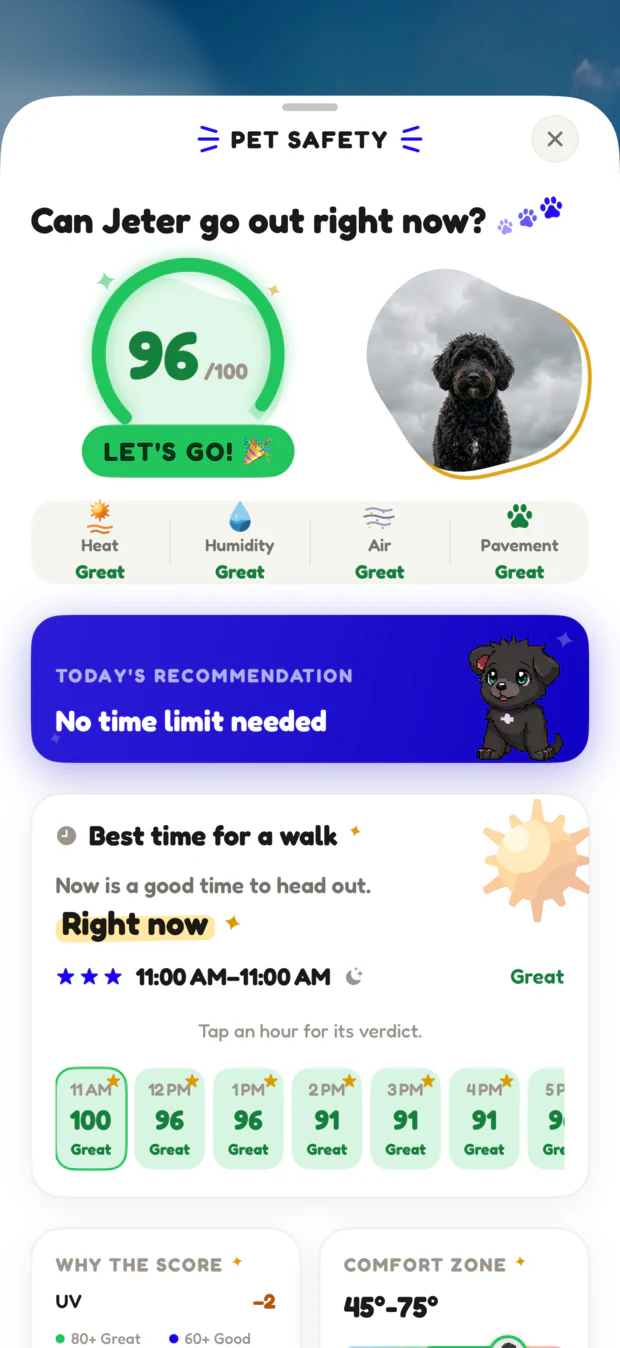
In the sum, a humidity point equals a degree. Then heat does extra work.
People reach for ratios here: five points of humidity equals ten degrees of heat. Our model is simpler. Inside the sum the exchange rate is one to one: 84°F at 76% and 80°F at 80% both total 160 and sit the same distance past the line.
The weighting lives in the slope: how many score points each unit over 150 costs, set by air temperature alone.
- 70°F: 0.5 points per unit over the line.
- 74°F: 0.97.
- 78°F: 1.43.
- 82°F: 1.90.
- 88°F and above: 2.60, where it stops climbing.
So a degree of heat counts twice: in the sum like a humidity point, and again by steepening what every unit in that sum costs. That is the honest version of "humidity moves the score more than degrees do". Humidity pushes you over the line; heat decides how far you fall. For temperature's own thresholds, see the safe walking temperature guide.
The slope stays gentle in the 70s because the 150 rule is an exertion rule, not a walking ban. Cross the line below 80°F and the app raises a "skip the run" flag rather than dropping the number, matching how the AVMA frames warm weather exercise: move the walk to cooler hours, take breaks, carry water, and treat overweight and short-nosed dogs as higher risk. At 80°F and above, that flag gives way to the cap.
Two afternoons, scored
Take a baseline dog, comfortable to 75°F with a hard ceiling at 90°F. Here is the comparison that convinced us the weighting was right:
| The hour | Comfort curve | Humidity penalty | Hour arithmetic | What the app shows |
|---|---|---|---|---|
| 84°F at 80% humidity | 21 | -29.9 | 0 | Risk |
| 88°F at 30% humidity | 54 | 0 | 54 | Caution |
| 76°F at 75% humidity | 94 | -1.2 | 93 | Good, skip the run |
| 80°F at 70% humidity | 66 | 0 | 66 | Risk |
The last two rows are where "primary factor" starts costing points. At 80°F and 70% the severity table turns Risk, and a primary at Risk caps the hour below 40 however pleasant the arithmetic: 66 becomes Risk. At 76°F and 75% the sum is past 150 but the air is under 80°F, so humidity reads Caution, the hour is capped out of Great, and the app raises "skip the run" instead.
The first two rows are the point. The cooler hour is the dangerous one. 84°F reads as an ordinary summer afternoon and scores zero; 88°F reads hot and scores 54. A thermometer gets that backwards, which is why we built the second pass.
Now the honest part. You will have read that a humid 80°F is worse than a dry 95°F. Our model does not agree with the strong form of that. Both land in Risk, and the dry 95°F lands lower, because 95°F is past where a dog regulates however dry the air is. The shorthand is directionally right and numerically overcooked. The comparison that survives the arithmetic is row one against row two.
One caveat: the comfort curve column uses feels-like, which the app takes from the platform provider's apparent temperature, and we have written about where the score and feels-like diverge. For the rows above we substituted the NWS heat index, so that column is close rather than exact. The penalty and the caps are exact.
All of this runs on your own city's hourly forecast rather than a rule of thumb, and the app shows the arithmetic instead of asserting a number, so you can disagree with it intelligently. See how the Pet Safety Score works, or get WeatherPets free on the App Store.
The humidity number for your city
Since the trigger is 150 minus the air temperature, every city has its own figure. Our dataset carries NOAA 1991-2020 Climate Normals from the NOAA National Centers for Environmental Information, and 70 US cities in it hold full monthly normals. Each city's average July high gives the humidity at which the penalty switches on during a typical peak-summer afternoon.
| City | Average July high | Humidity where the penalty starts |
|---|---|---|
| Phoenix, Arizona | 106.5°F | 43% |
| Dallas, Texas | 96.9°F | 53% |
| Miami, Florida | 90.6°F | 59% |
| Atlanta, Georgia | 90.1°F | 60% |
| Denver, Colorado | 89.9°F | 60% |
| Chicago, Illinois | 84.5°F | 65% |
| Seattle, Washington | 77.4°F | 73% |
| San Francisco, California | 66.3°F | Never, in an average July |
Read Phoenix and Denver together, because they break the intuition. Denver is not humid, yet its 60% trigger matches Atlanta's, and Phoenix has the country's lowest trigger at 43% because it is so hot that almost no moisture is needed to cross the line. Dry cities do not get a pass. They get a lower bar. San Francisco's average July high sits below the 70°F floor, so there the factor never switches on.
We ranked the muggiest US cities for dogs using the same dataset a different way, by how little the night cools off, which proxies the moisture these normals do not record.
When to walk anyway
None of this says stay indoors. There are usually good hours inside a bad one.
- Early is still better, even though the sum is worse. Relative humidity peaks at dawn, when air is coldest and its moisture has not changed, so the sum is highest then and lowest mid-afternoon. The afternoon is not safer. On a 70°F dew point day, 72°F at 93% sums to 165 and scores Good, while 90°F at 52% sums to 142 and scores Risk, because the heat has taken over. The sum tells you about humidity, not about the day.
- Read the pair, never the sum alone. Under 140, humidity costs nothing. 140 to 150 above 70°F is the zone to shorten. Past 150 with air at 80°F or more is the cap.
- Treat the line as an exercise ceiling. Crossing 150 in the 70s means walking instead of running, and turning back sooner than you meant to.
- Adjust for your own dog. Flat-faced, senior, very young, overweight and thick-coated dogs cross these lines earlier. The app moves their bands; a table cannot.
- Check the ground separately. A humid overcast day can be fine underfoot while a dry sunny one is not: its own estimate.
Frequently asked questions
Is 80°F with high humidity dangerous for dogs?
80°F is exactly where our model stops treating humidity as a nuisance. At 80°F with 70% humidity the severity table turns Risk, and because humidity is a primary factor it caps the whole hour below 40 regardless of how the rest of the arithmetic went. Below 70% at that temperature it takes off nothing at all. The gentler "skip the run" flag lives a little cooler, around 76°F at 75%, where the sum is past 150 but the air is still under 80°F.
What humidity is too high to walk a dog?
There is no single number, and any article giving you one is guessing. The threshold moves with temperature: roughly 150 minus the air temperature in Fahrenheit. At 70°F you need 80% humidity before it counts, at 80°F it is 70%, at 90°F it is 60%. Below 70°F our model does not count humidity at all, because there is no real heat load to shed.
Why do dogs struggle more in humid heat?
Panting is evaporative cooling: a dog moves air over a wet tongue and airway, water evaporates, heat leaves with it. Evaporation needs the air to have room for more water, so as humidity climbs the same panting shifts less heat. The dog works just as hard and achieves less. That is why cooling advice for heat-affected dogs is water plus airflow, not water alone.
Is a humid 80°F really worse than a dry 95°F?
Not in the strong form. In our model 80°F at 70% and a dry 95°F both end in Risk, and the dry 95°F sits lower, because that much heat is past where a dog regulates however dry the air is. The comparison that does hold is closer in: 84°F at 80% scores 0 while 88°F at 30% scores 54.
What humidity number should I watch for in my city?
Take 150 and subtract your city's average summer high. From NOAA 1991-2020 normals that is 43% in Phoenix, 53% in Dallas, 59% in Miami, 60% in Atlanta and Denver, 65% in Chicago and New York, 73% in Seattle. Above that on a typical July afternoon, humidity is actively removing points.
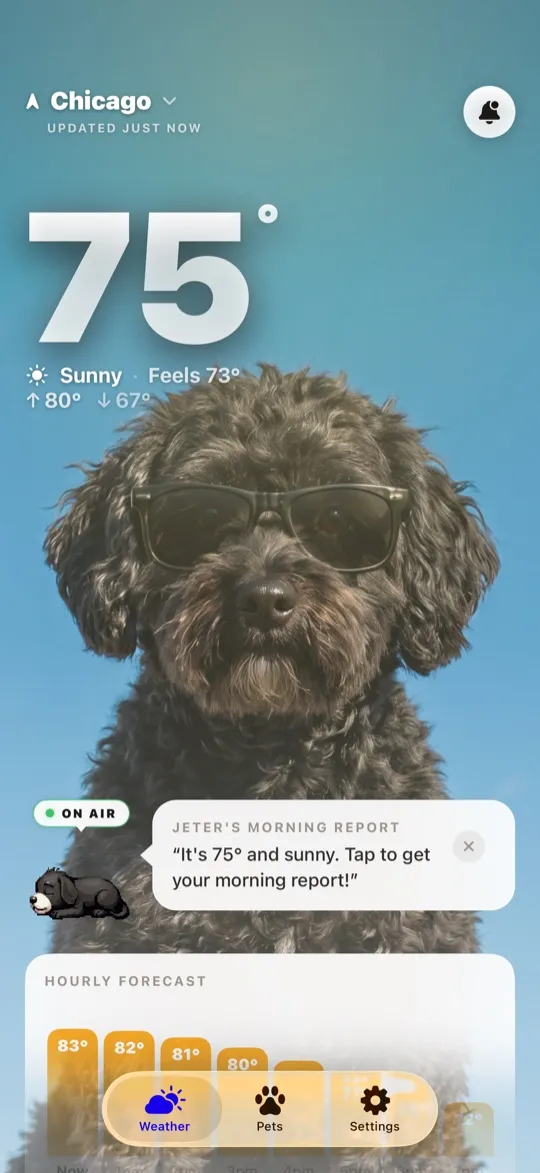
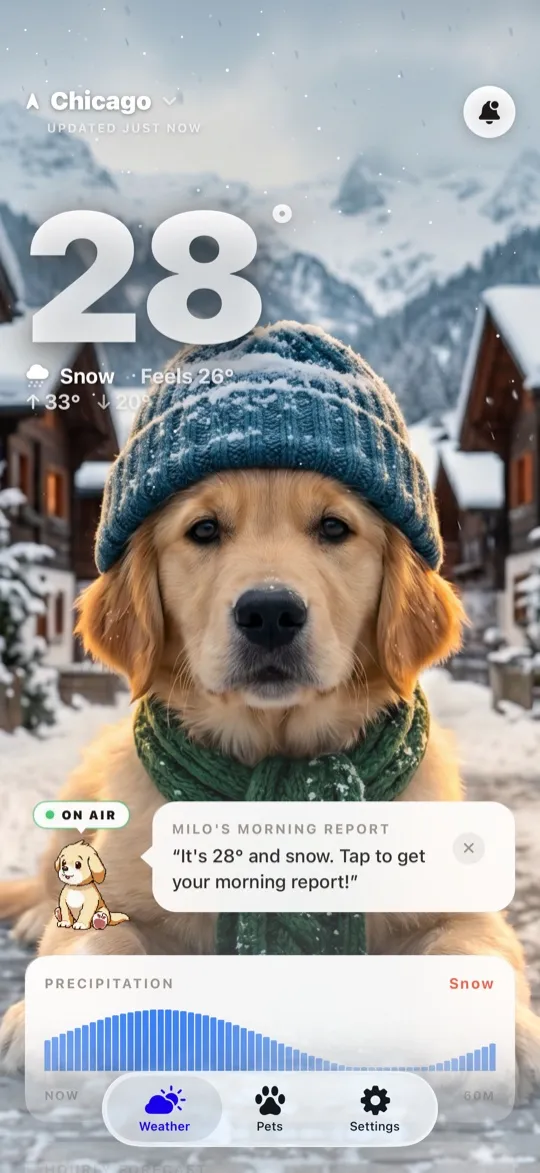
Your daily forecast, delivered by your own pet.

A note on health: This article is general information, not a substitute for professional veterinary advice. If you are worried about your dog overheating, or about any serious or emergency health concern, contact your veterinarian right away. Our guidance draws on trusted veterinary and government sources, including those linked above.
