Pet Safety Score Methodology: How the Score Is Built
Most scores in pet apps are a vibe with a number stapled to it. Ours is arithmetic, and all of it is auditable. Here is the model: the five inputs, what each is worth, the adjustments that move a pet's comfort bands, and two days run through the engine for two very different dogs.
Key takeaways
- Three primary inputs, two secondary. Temperature, humidity and air quality move the number anywhere; UV and wind only lower the ceiling.
- A primary factor at risk caps the score at 39, so three pleasant readings and one dangerous one never average to green.
- The comfort curve is a taper, not a cliff. 100 inside the ideal band, 35 at the hard limit, 0 ten degrees past it.
- Breed grading moves the bands by up to 14 degrees, from published odds ratios rather than our opinion of a breed.
- Breed grade separates dogs in winter, not in a heat wave. At 82 degrees and 70 percent humidity a Siberian husky scores 38 and a French bulldog 31, both Risk. At 32 degrees the same two are 45 points apart.
Quick answer
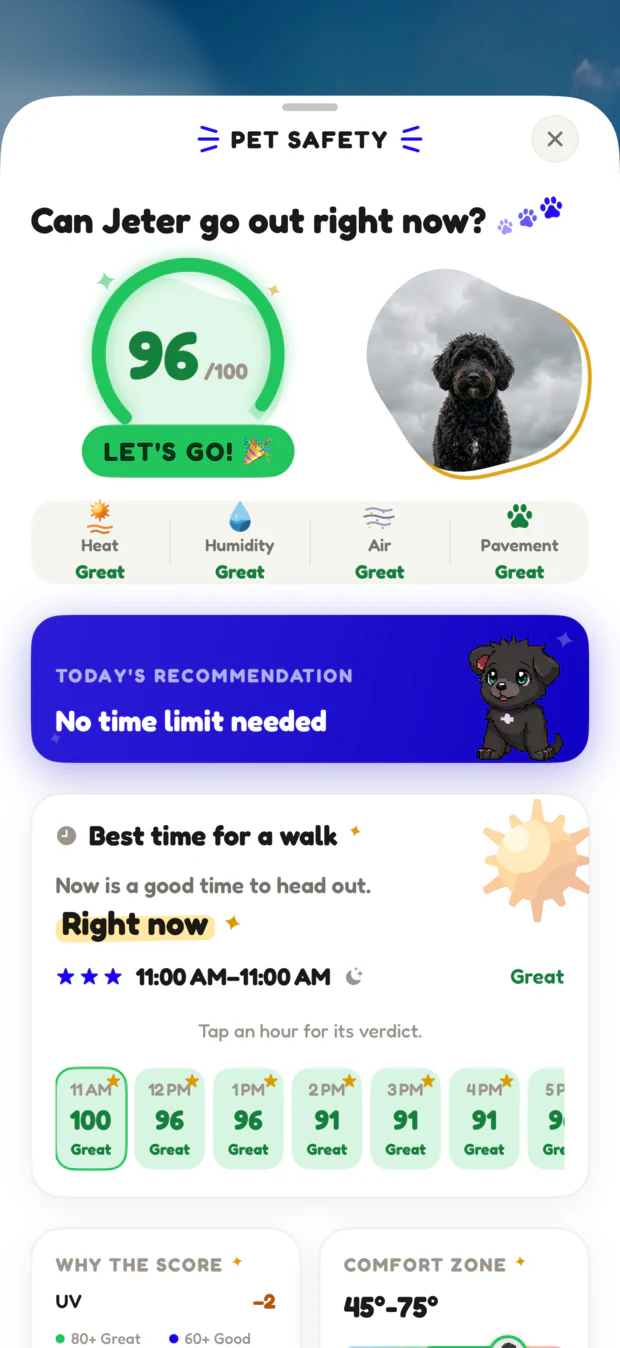
The Pet Safety Score is a 0 to 100 read on whether the weather suits one specific animal right now. Above 80 is Great, 60 to 79 Good, 40 to 59 Caution, below 40 Risk. What the number means day to day lives in the canonical Pet Safety Score explainer. This page is the engineering behind it.
It runs in two stages. First the pet's comfort bands are derived from its profile: species, breed grade, size, weight, age, coat and health conditions. Those bands are four numbers: a hard cold limit, an ideal low, an ideal high, a hard heat limit. Then each forecast hour is scored against them, penalties come off, caps are applied, and the result is clamped to 0 through 100. Every point is recorded with its source and the signed values sum to the number on screen, which is why the app shows a breakdown that adds up instead of a gauge you have to trust.
The five inputs, in order of weight
Weighting here is not five percentages totalling 100. It is a hierarchy of what each factor may do to the number.
| Input | Tier | What it is allowed to do |
|---|---|---|
| Feels-like temperature | Primary | Sets the base score from the pet's comfort curve, 0 to 100. Can cap everything else. |
| Humidity (the 150 rule of thumb) | Primary | Subtracts up to the whole score, and can cap the total at 39. |
| Air quality (AQI) | Primary | Subtracts, caps at 39, or zeroes the hour outright at hazardous. |
| UV index | Secondary | Lowers the ceiling only, to 96, 90 or 82. Never creates a danger. |
| Wind gusts | Secondary | Lowers the ceiling only, plus a small hourly penalty above 25 mph. |
Temperature is the base. Inside the ideal band the hour scores a flat 100. Outside it, the score tapers to 35 exactly at the hard limit, then decays to 0 over the next ten degrees: a hard limit is where danger begins, not where it is complete. Temperature means feels-like, which is why an 82 degree hour can score like an 86 degree one. Feels-like hides its own cause, a trap we covered in why feels-like temperature misleads for pets, so humidity is scored again on its own terms.
Humidity is graded on the 150 rule, air temperature in Fahrenheit plus relative humidity. Be clear about what that rule is: a widely repeated rule of thumb among owners and handlers, not a published veterinary standard, and we have found no primary source that establishes it. We use it as a shape, not a verdict. Points come off for every unit above 150, on a slope rising from 0.5 per unit at 70 degrees to 2.6 at 88. Humidity only disables panting when there is heat to shed, so a muggy 72 degree morning is a pacing problem, not a danger.
Air quality uses the EPA Air Quality Index categories. Unhealthy for sensitive groups costs 10 points, unhealthy 20, very unhealthy pins the hour near zero, and hazardous is one of only two hard zeros in the model. A declared respiratory or cardiac condition doubles those penalties. What the thresholds mean for a walk is in our guide to what AQI is too high to walk your dog.
UV and wind are deliberately weak, and making them subtractions was a defect we shipped and fixed: ten points off a 34 pushed a warm morning past the stay-indoors line on the strength of a sunny sky. A secondary factor may cap how good a day is; it must never make a marginal day dangerous. Pavement rides inside temperature: asphalt is estimated from air temperature, UV and cloud, then costs 2 points per degree above 110.
Breed, coat, size and age adjustments
Our default dog is comfortable from 45 to 75 degrees, with hard limits at 20 and 90. Each adjustment below is a signed change to those four numbers, applied in order, then clamped so no stack of modifiers makes an absurd animal.
Breed grading is the largest lever, and it grades heat and cold as independent axes. A greyhound is bad at both; a chow chow is superb in cold and the worst breed in the published heat data. One slider cannot express either animal. The grades come from Hall, Carter and O'Neill's 2020 study of heat-related illness in 905,543 UK dogs, whose odds ratios are relative to a Labrador. No breed gets a courtesy grade, and none gets a penalty it has not earned: a breed whose confidence interval crosses 1 is not distinguishable from the Labrador baseline, so it takes no heat grade at all. The worked example below is where that rule cuts against the intuitive answer.
| Adjustment | Ideal band | Hard limits |
|---|---|---|
| Heat grade: elevated (odds ratio about 2 to 3) | High end down 4 | Heat limit down 2 |
| Heat grade: high (about 4 to 7) | High end down 6 | Heat limit down 4 |
| Heat grade: extreme (above 10) | High end down 9 | Heat limit down 7 |
| Cold grade: arctic (sled and mountain breeds) | Low end down 10 | Cold limit down 14 |
| Cold grade: high (sighthounds, hairless, toy builds) | Low end up 5 | Cold limit up 7 |
| Coat: double (dense undercoat) | High end down 4 | Heat limit down 2 |
| Coat: thin or single | Low end up 3 | Cold limit up 5 |
| Senior | Low up 5, high down 5 | Cold up 4, heat down 3 |
| Puppy or kitten | Low up 6, high down 4 | Cold up 5, heat down 2 |
| Carrying extra weight | High end down 4 | Heat limit down 3 |
The rule running through that table: sensitivity shrinks the ideal band strongly and moves the hard cutoffs only mildly. Hard limits are for genuine danger; everyday sensitivity belongs in the curve, where it lowers a score without slamming a door.
Coat is counter-intuitive. A thin coat earns a cold-side penalty and no heat bonus, because granting one is what made older versions treat greyhounds as heat tolerant while they carry four times a Labrador's odds of heat illness. A double coat tightens the heat side rather than loosening it: the 2025 Frontiers in Animal Science review of heat stress in dogs puts dense coats beside flat faces and obesity as traits that cut thermoregulation.
All of this runs on your own pet's profile, not a generic dog. The Pet Safety Score folds temperature, humidity, UV, air quality and pavement heat into one read for the animal at your door. Meet your WeatherPet on the App Store.
Why humidity and air quality can override temperature
Averaging five factors is the obvious approach, and it is wrong: three comfortable readings outvote one lethal one, and no dog dies of an average. So the primary factors carry caps. If temperature, humidity or air quality reaches risk, the whole score is capped at 39; if one is merely at caution, the cap is 79. Both caps are recorded as contributions, so the breakdown still adds up.
The humidity risk gate is tighter than the 150 rule itself, on purpose. A sum of 150 or more only reads as risk when the air is at least 80 degrees and humidity is at least 70 percent. That pair is our own calibration, not a veterinary threshold, and we would rather say so than dress it up: 80 plus 70 is exactly 150, so it is the muggiest way to reach the number rather than the driest. A hot but dry hour reads as caution instead, because dry heat is already temperature's job. The case for weighting the moisture side that heavily is in why humidity moves the score more than degrees do.
One more cap exists purely for honesty: a missing AQI deducts nothing, so with no reading the score is capped at 79 and the pill says No data. Better uncertain than wrong.
Worked example: 82 degrees and 70 percent humidity for two dogs
Two dogs, breed and coat only. Both start from the default 20 / 45 to 75 / 90 and use only rows from the table above.
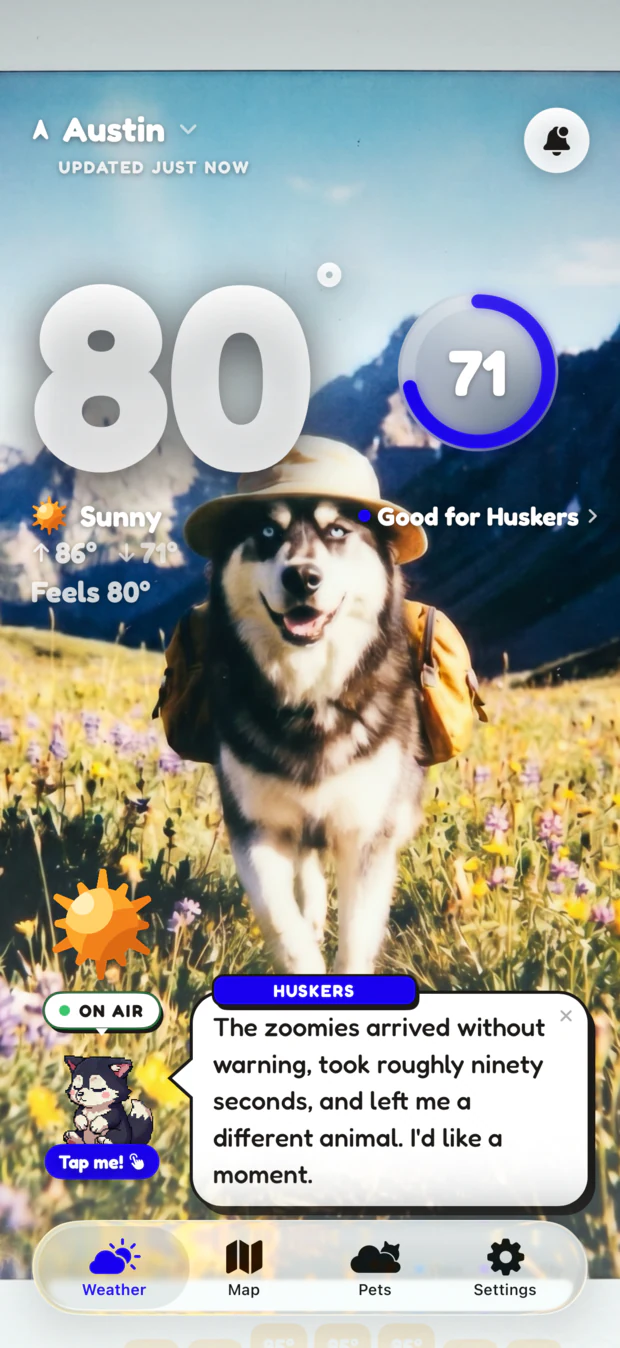
The Siberian husky takes the arctic cold grade: ideal low down 10 to 35, cold limit down 14 to 6. It takes no heat grade at all, because the study puts it at an odds ratio of 1.18 with a confidence interval of 0.28 to 5.06, which straddles 1. Its only heat-side adjustment is the double coat, 4 off the ideal high and 2 off the heat limit. Result: 6 / 35 to 71 / 88.
The French bulldog sits at 6.49, squarely in the high heat grade: 6 off the ideal high, 4 off the heat limit. Its thin single coat adds 3 to the ideal low and 5 to the cold limit. Result: 25 / 48 to 69 / 86.
The day: 82 degrees, 70 percent humidity, UV 7, light wind, good air, feels-like 86. The unadjusted guidance underneath is in the temperature thresholds for walking a dog.
| Contribution | Siberian husky | French bulldog |
|---|---|---|
| Comfort curve base at feels-like 86 | 42.6 | 35.0 |
| Humidity, 150 rule | minus 3.8 | minus 3.8 |
| Pavement, asphalt about 110 degrees | minus 0.4 | minus 0.4 |
| Score | 38, Risk | 31, Risk |
Seven points apart, and both in Risk, which is the opposite of what the breed grades predict. These two are nowhere near each other in the published data and the model honours that: the husky carries no heat penalty whatsoever. It lands under the line anyway, because on a hot, muggy hour the comfort curve and the 150 rule do nearly all the work. Breed grade decided how far under the line each dog already was, not whether it was under it.
The day these two really come apart is not a hot one. Put both in 32 degrees with a 12 mph wind, a feels-like of about 23, and the husky scores 73, a comfortable Good. The French bulldog scores 28, a Risk, because 23 is two degrees under its hard cold limit of 25. Same street, same minute, 45 points apart. Summer flattens these two together; winter is where the profile earns its keep.
What the score does not see
A companion piece covers what the Pet Safety Score cannot see about your day. This section is narrower: where the arithmetic itself stops.
- Air quality is one station's category, not your street. It cannot tell a smoky valley from a clear ridge.
- Pavement is an estimate. It does not know whether your route is shaded, grassy or asphalt.
- Pollen is opt-in. It only penalizes a pet whose owner declared an allergy.
- Cold-blooded pets are not scored. The warm-blooded curve inverts for reptiles, fish and amphibians, so the app shows an honest not-graded state.
- It is not a diagnosis. Thresholds draw on published guidance, including the AVMA's cold weather animal safety guidance and the EPA UV Index scale.
That last one is not false modesty. Every modifier's direction is backed by published guidance; several magnitudes, the humidity risk gate among them, are our own calibration, and the code says so.
Frequently asked questions
What does the Pet Safety Score measure?
How the weather right now sits against one specific animal's tolerance, on a 0 to 100 scale. Five inputs feed it: feels-like temperature, humidity, air quality, UV and wind. The first three can move the number anywhere; UV and wind only lower the ceiling.
Why is my dog's score different from my neighbor's?
The comfort bands are per pet. Our default dog is comfortable from 45 to 75 degrees with hard limits at 20 and 90. Breed grade, age, weight, coat and health conditions shift those four numbers before any weather is scored. A husky and a French bulldog end up 19 degrees apart on the cold limit alone.
Does the score use humidity and air quality?
Yes, and both are primary, so either can cap the score alone. Humidity is graded on the 150 rule, a rule of thumb adding air temperature in Fahrenheit to relative humidity, not a published veterinary standard. Air quality uses the EPA AQI categories. If either reaches risk the total is capped at 39, however pleasant the temperature.
How often does the Pet Safety Score update?
Every forecast hour is scored individually and the headline refreshes with the forecast. It is not the current hour alone: it blends the current hour and the next two at 60, 30 and 10 percent, so a walk cannot be graded green while conditions fall apart an hour into it.
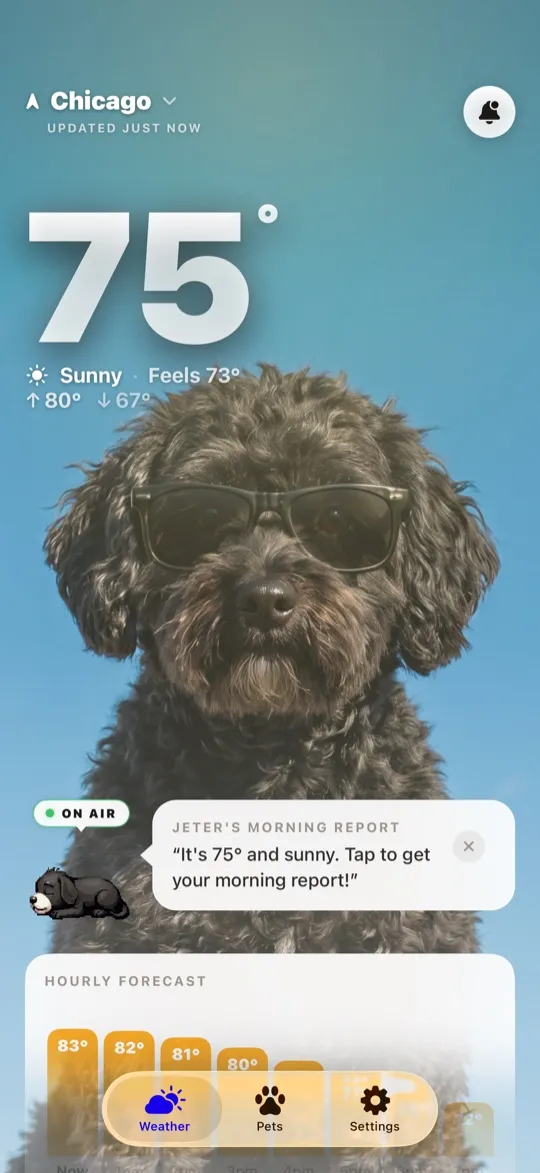
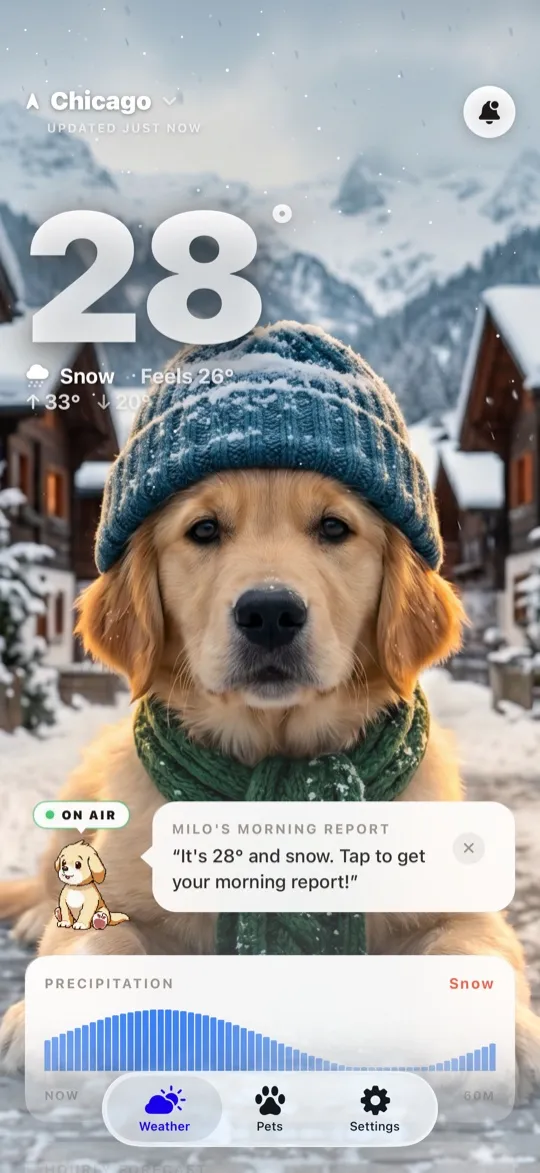
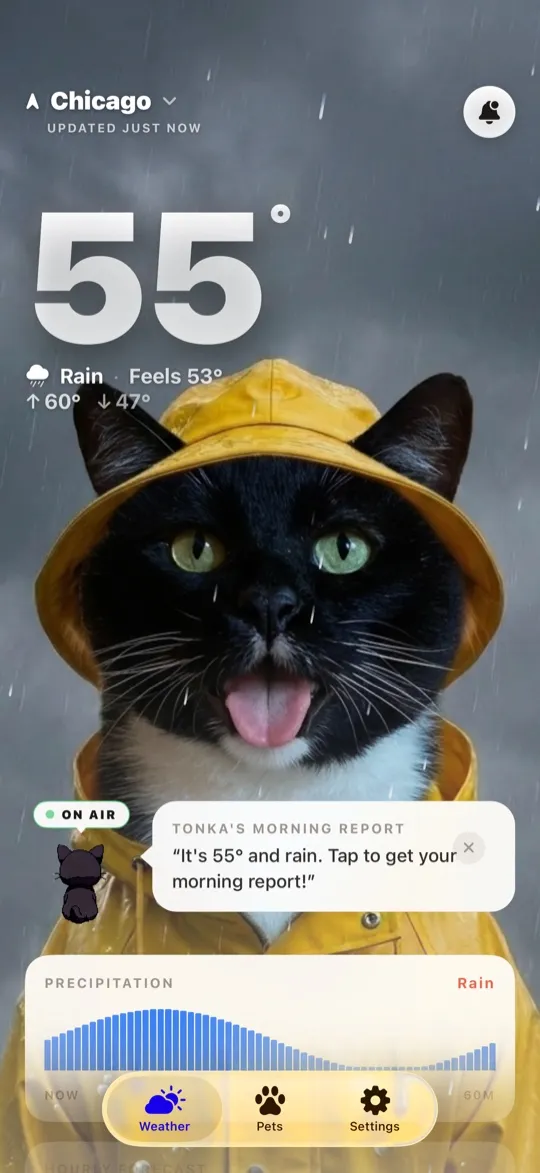
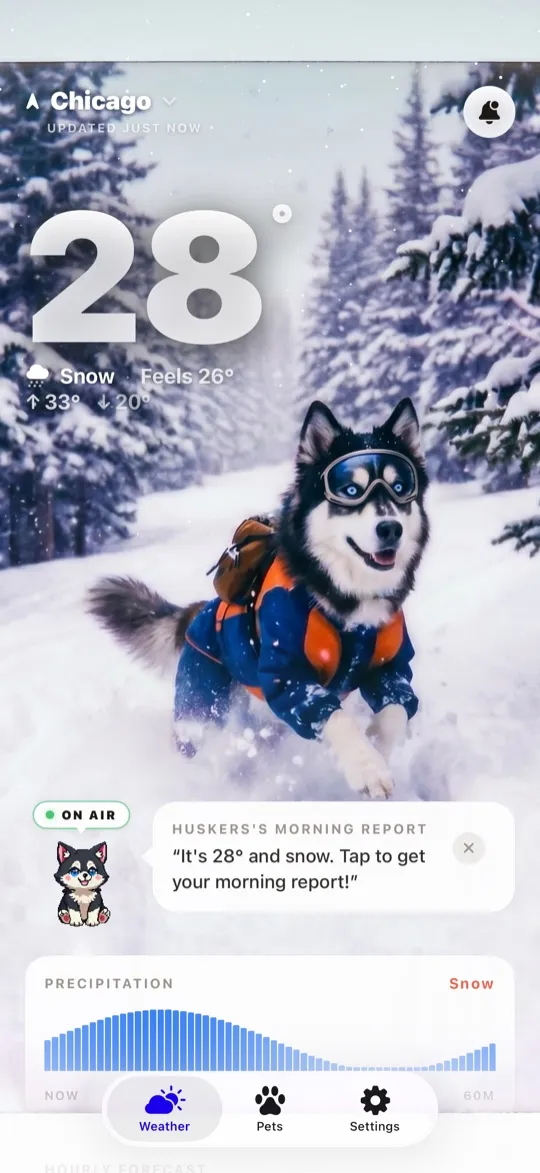
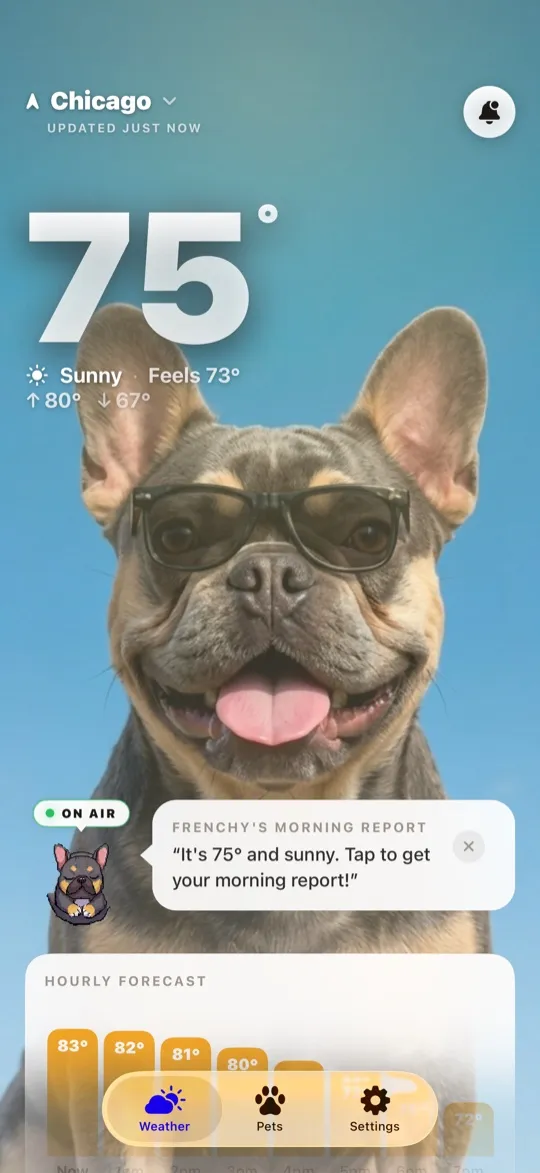
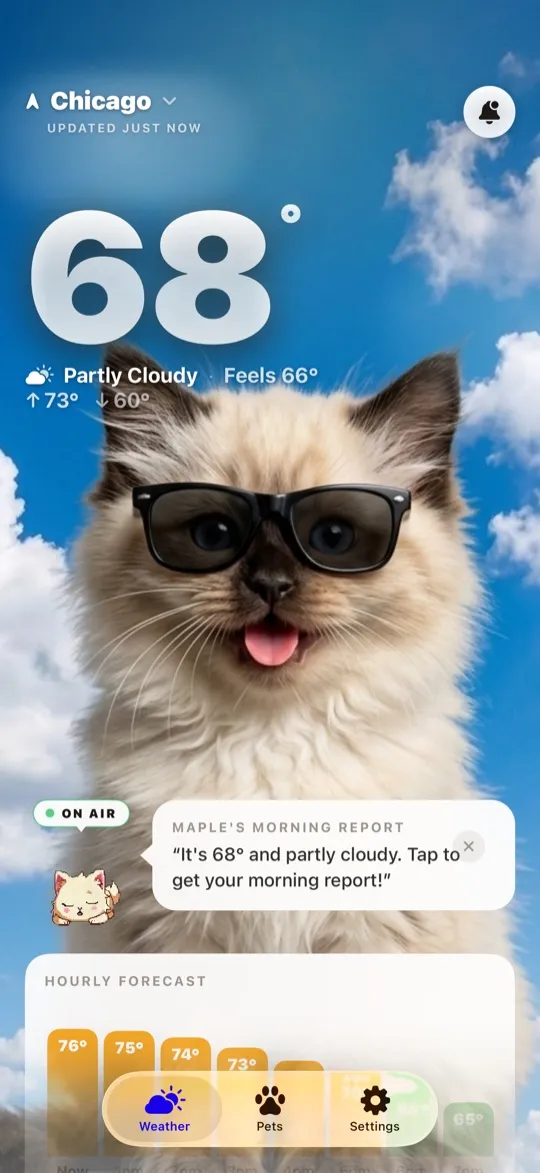
Your daily forecast, delivered by your own pet.

A note on health: This article is general information, not a substitute for professional veterinary advice. If you are worried about your pet overheating, struggling in the cold, or any serious or emergency health concern, contact your veterinarian right away. Our guidance draws on trusted veterinary sources, including those linked above.
