The Rainbow Bridge Poem: Who Really Wrote It, and Why It Works
For more than sixty years the most comforting piece of writing in the English language about losing an animal had no author. It arrived folded into sympathy cards, pinned to vet clinic noticeboards, forwarded in chain emails, always unsigned. Then in 2023 someone finally tracked it down, and the answer turned out to be a Scottish teenager writing in her bedroom in 1959, the day after her dog died. Here is the real story, why the poem holds up, and what it is actually saying.
Key takeaways
- It was written in 1959 by Edna Clyne-Rekhy of Inverness, Scotland, then a teenager, the day after her Labrador Major died.
- She never signed it and never published it. She handed copies to friends who were grieving, and it went from there.
- The world found out in 2023, when art historian Paul Koudounaris traced it back to her and National Geographic reported the finding.
- It exploded in 1994, after the Dear Abby column printed it for an audience of roughly 100 million readers.
- Grieving an animal this hard is normal. A 2026 study found pet loss can meet the clinical bar for prolonged grief, and the AVMA says so in policy.
What the poem actually says
The version that circulates most widely opens with the line "Just this side of heaven is a place called Rainbow Bridge." From there it describes a meadow with hills, food and water and sun, and animals who are warm and comfortable. The animals who were old are young again. The ones who were hurt or sick are whole. They play together, and they are content, except for one thing: each of them misses somebody who had to be left behind.
Then a moment comes when one animal stops and stares into the distance, and breaks away from the group, and runs. And you meet, and there is a reunion, and you cross the bridge together.
That is the whole shape of it. Roughly three hundred words, no rhyme, no complicated imagery. You can read the full text inside National Geographic's reporting on its origin. We have deliberately not reprinted it in full here, and the reason is in the section on copyright further down.
Who wrote the Rainbow Bridge poem
Edna Clyne-Rekhy, an artist from Inverness in the Scottish Highlands. She was a teenager in 1959 when her Labrador Major died, and she wrote the piece the following day, sitting with the loss and putting down where she wanted him to be. She titled it and then did nothing with it. No submission, no publication, no name attached.
What she did do was give it away. When a friend lost an animal, she typed or wrote out a copy and handed it over. Those copies got copied. For the next six decades it moved person to person, through the least glamorous distribution network imaginable: photocopiers, parish newsletters, clinic waiting rooms, and eventually email forwards and message boards. Nobody was tracking it, because nobody owned it.
Clyne-Rekhy had no idea. She was in her eighties before anyone told her that the thing she wrote at sixteen or so had been read at the bedsides of a very large number of dying animals all over the world.
How it was finally traced
The credit goes to Paul Koudounaris, an art historian in Tucson, Arizona, who had spent roughly a decade researching pet cemeteries and animal mourning for a book. He kept running into the poem and kept finding that nobody could say where it came from.
So he worked it like a case. He assembled a list of around twenty-five candidate names, went through United States Copyright Office records, and eliminated them one at a time. What remained pointed to Scotland, and to Clyne-Rekhy. The clinching evidence was physical: the original handwritten manuscript, on notebook paper, with her sister's crossed-out writing on the back of the sheet. He published his account in February 2023 on The Order of the Good Death, and National Geographic reported it days later.
One honest note on certainty. This is one researcher's dossier, corroborated by a physical document and reported by a major outlet. It has not been re-investigated by a second independent team. It is very widely accepted, and the manuscript is hard to argue with, but the accurate way to say it is "identified in 2023" rather than "proven in court."
A timeline of the poem's life
| When | What happened | Why it mattered |
|---|---|---|
| 1959 | Edna Clyne-Rekhy writes it in Inverness, the day after her Labrador Major dies | Written for herself, not for publication. No title page, no name. |
| 1960s to 1980s | Copies passed hand to hand between grieving owners | Spread without attribution, which is how it became anonymous. |
| Early 1990s | Several people are credited as the author, some sincerely | Paul Dahm, William N. Britton and Dr Wallace Sife are all associated with it. |
| February 1994 | Dear Abby prints it in her advice column | Roughly 100 million readers at once. This is the moment it goes global. |
| Late 1990s onward | Email forwards, pet loss forums, memorial sites | Dozens of small variants appear as each copy gets edited. |
| February 2023 | Paul Koudounaris identifies Clyne-Rekhy; National Geographic reports it | Sixty-four years after it was written, the author finally has her name on it. |
The people who were credited before
Worth saying clearly, because the internet has a habit of turning this into a story about frauds, and mostly it was not. Paul Dahm, a grief counsellor in Oregon, was the name attached to the poem for years and published a book around it. William N. Britton said in 1994 that the story had been told to him by a Native American shaman. Dr Wallace Sife, who founded the Association for Pet Loss and Bereavement, believed it was a variant of a poem of his own.
When a piece of writing spreads unsigned for thirty years, people who encounter it early and love it genuinely start to feel connected to it, and memory does the rest. The manuscript settled the question. It did not make everyone who got it wrong a liar.
Why there are so many different versions
Because it never had a canonical printing to check against. Every hop introduced a small edit: a word modernised, a line broken differently, a sentence dropped by a photocopier that cut off the margin. If the copy your vet gave you does not match the one on a memorial website, that is the reason.
There is also a genuinely separate work in circulation. Steve and Diane Bodofsky wrote a rhyming version, which is its own piece rather than a variant of Clyne-Rekhy's. A good deal of what people share as "the Rainbow Bridge poem" is actually theirs. The UK charity Society for Companion Animal Studies lays out both.
Why we did not reprint the whole thing
This is the part almost every page about the poem gets wrong, so it is worth being straight about. The poem was written in 1959 by an author who was alive and well as recently as 2023. Under UK law that means copyright runs for her lifetime plus seventy years. It is not in the public domain, however freely it has been copied.
Koudounaris found fifteen filings under the name at the US Copyright Office from 1994 onward, none of them by Clyne-Rekhy, and several of them for completely unrelated works. Those filings do not create rights in her text and they do not remove hers. As far as anybody can tell she has never registered it, licensed it, or asked anyone for anything.
So the respectful thing, and the legally sensible thing, is the same thing: quote a line, name the author, and link out for the rest. She wrote it for free, for a friend, sixty-seven years ago. Putting her name on it is the least the internet can do at this point.
Why it works, when so much grief writing does not
Three reasons, and they are worth understanding if you are choosing something to read at a goodbye.
It makes no religious claim
It uses the word heaven and then declines to explain it. There is no deity, no judgement, no doctrine, no requirement to believe anything. That is why it works in a Catholic family and an atheist one and everything in between. It asks nothing of you.
It fixes the specific thing that hurts
The pain at the end of an animal's life is rarely abstract. It is that they were in pain, that they got old, that the last months were hard, that the last day was the hardest. The poem addresses precisely that and nothing else: the animals are warm, well fed, out of pain, and young again. It is targeted comfort.
It does not ask you to let go
Most bereavement language pushes toward acceptance and moving on. This one does the opposite. It says the relationship is paused, not finished. That instinct turns out to be closer to what people actually need. Research into what helps bereaved owners, including a thematic analysis of pet bereavement counselling in Omega, keeps landing on the same finding: what helps most is having the relationship itself taken seriously, not being talked out of it.
Grieving this hard is not an overreaction
Plenty of people read the poem privately and feel slightly ridiculous about how hard it hits. It is worth knowing that the evidence is now firmly on your side.
A study published in PLOS ONE in January 2026 looked at 975 adults and found that 7.5 percent of people who had lost a pet met the criteria for prolonged grief disorder. Among people who had lost both an animal and a human being, 21 percent named the animal as their most distressing bereavement. The study also found that grief symptoms present identically whether the one who died was a person or an animal, and argued that the diagnostic manuals are wrong to exclude pet loss.
Harvard Health's write-up put that 7.5 percent figure alongside the rates seen after losing a sibling, a close friend or a partner. And the American Veterinary Medical Association states in formal policy that animal loss causes distress comparable to the loss of a close human relationship.
If somebody has told you it was "just a dog," they are out of step with the research, the veterinary profession and roughly a hundred million Dear Abby readers.
Making the crossing a happy thing
The poem gets read at a lot of goodbyes, and it belongs there. But it has a second, less obvious use, and it is the one we would gently argue for: as a description of how you want to remember them, rather than only how you want to say goodbye.
The picture it paints is not a grave. It is a field, in good weather, with a healthy animal who is enjoying themselves. That is a much better place to keep somebody than the last hard week. If you want a starting point, our guide to joyful pet memorial ideas is built entirely around that idea, and if the grief is currently the loud part, pet loss support that is actually still running lists the helplines we have verified are open.
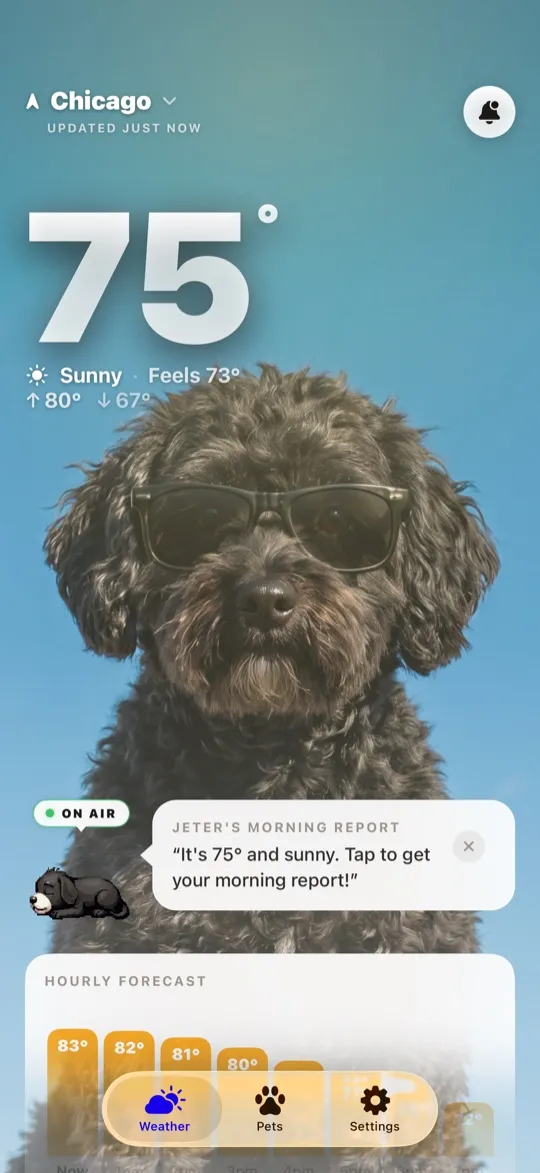
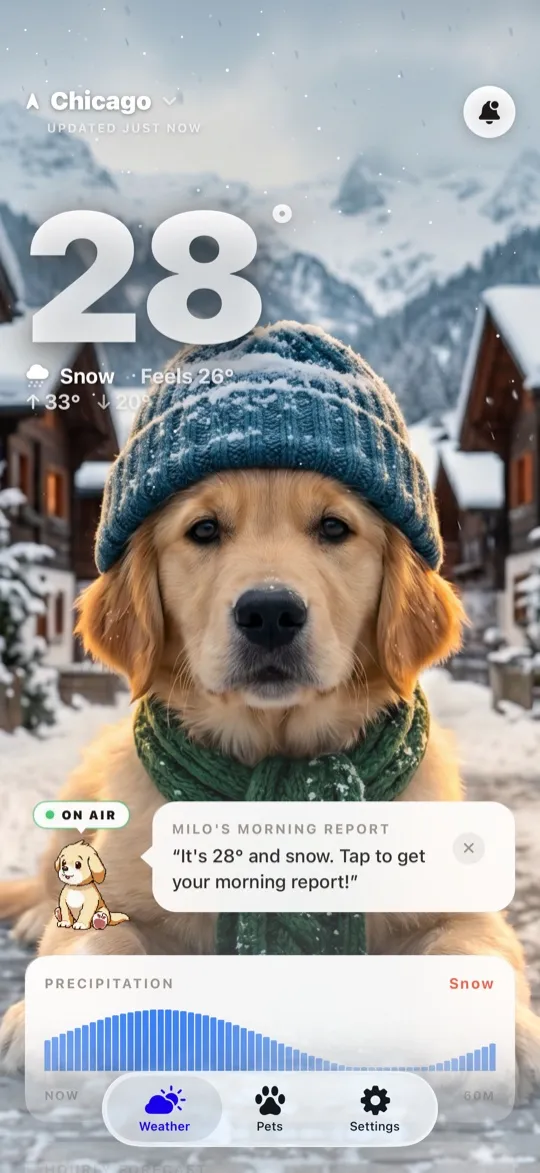
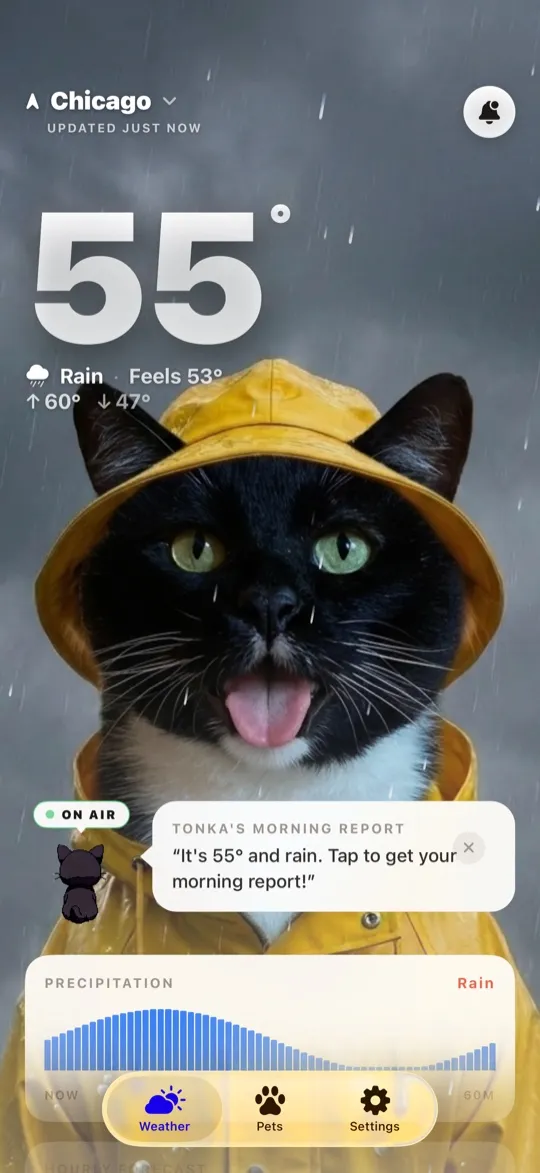
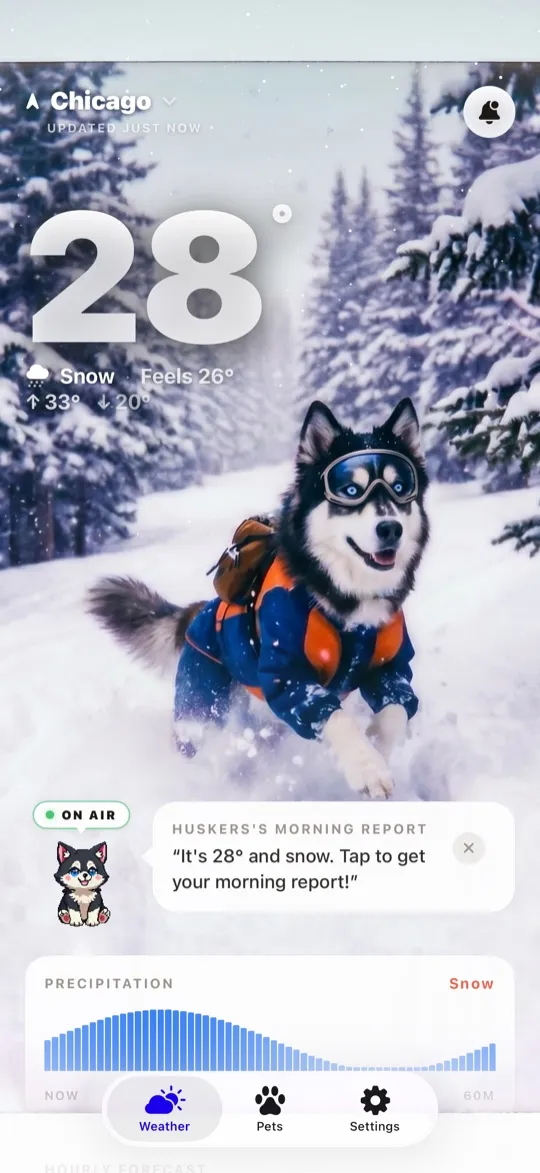
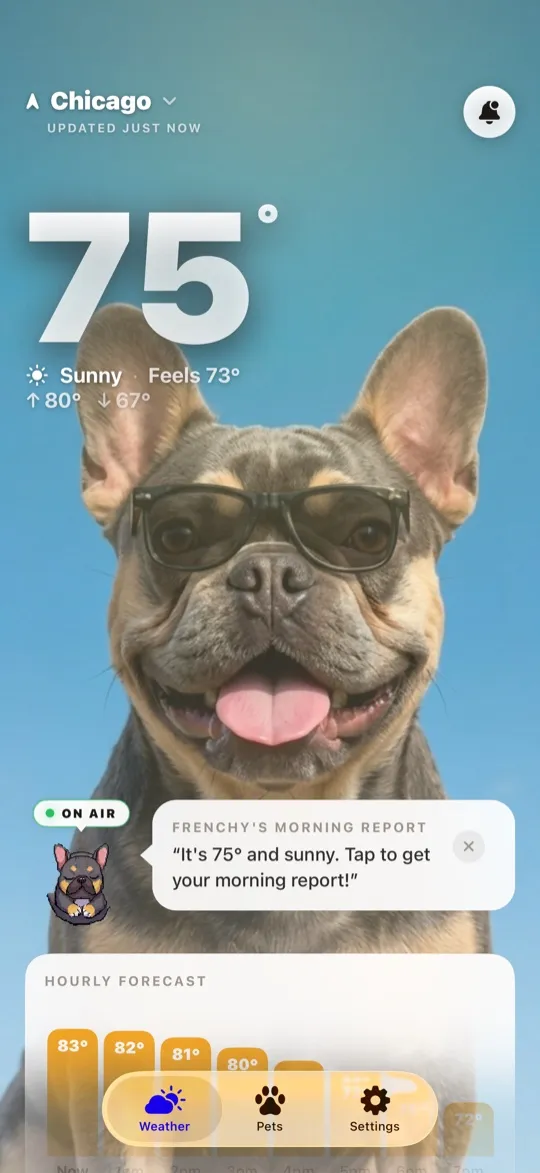
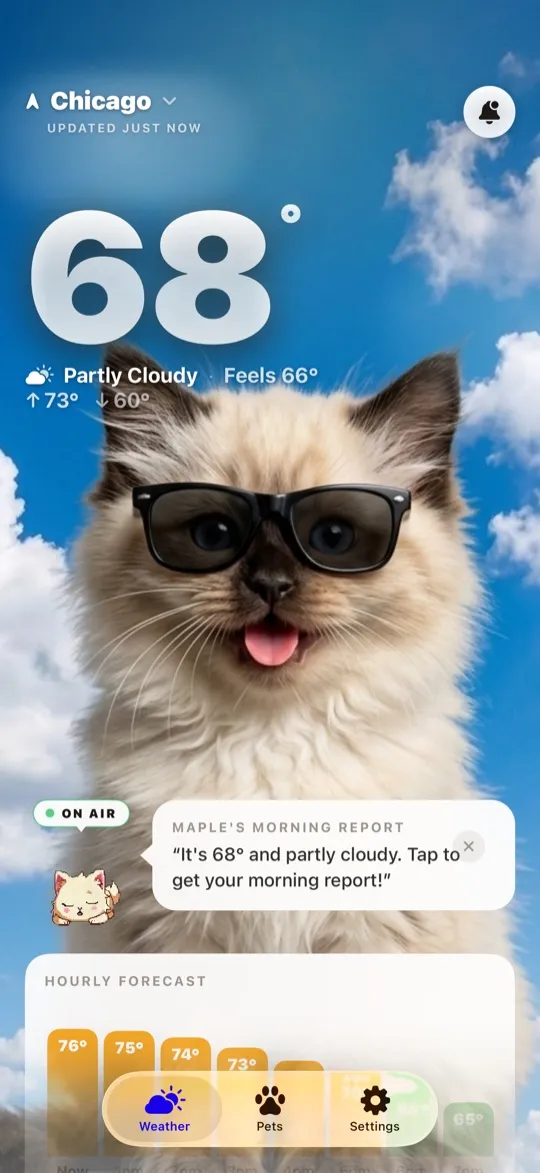
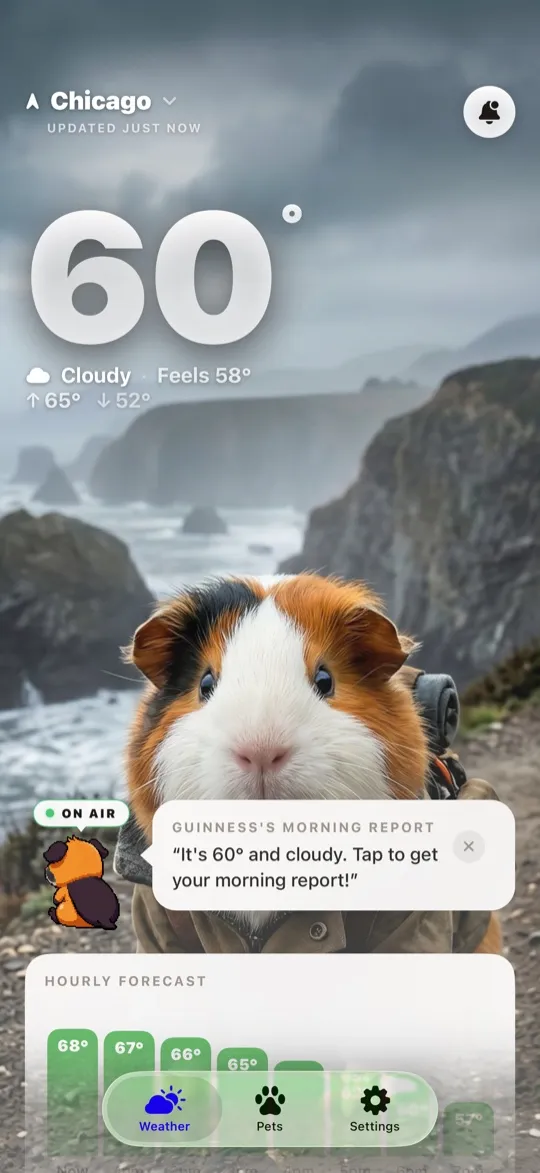
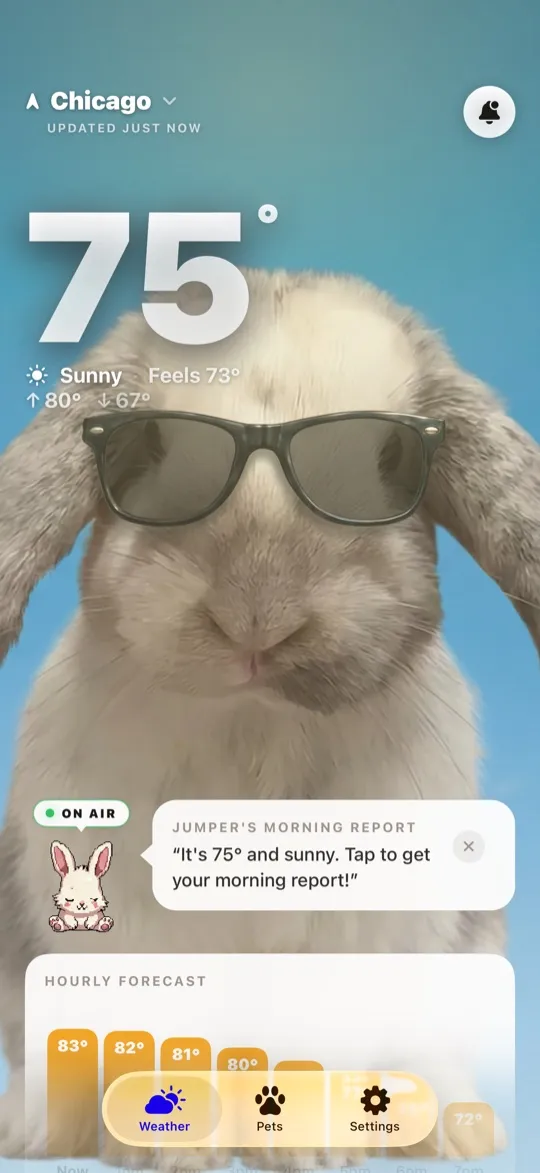
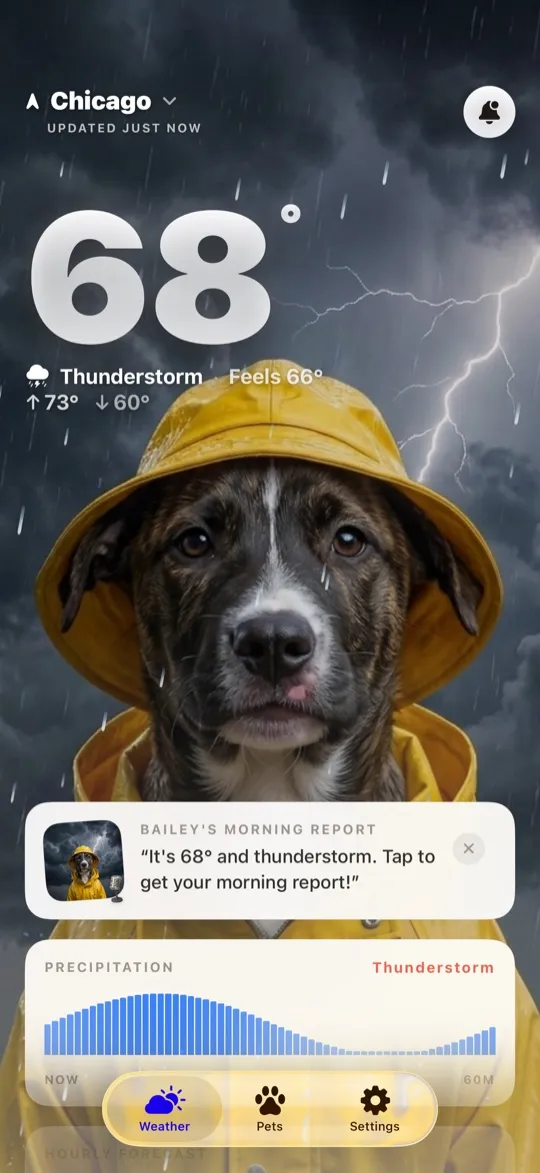
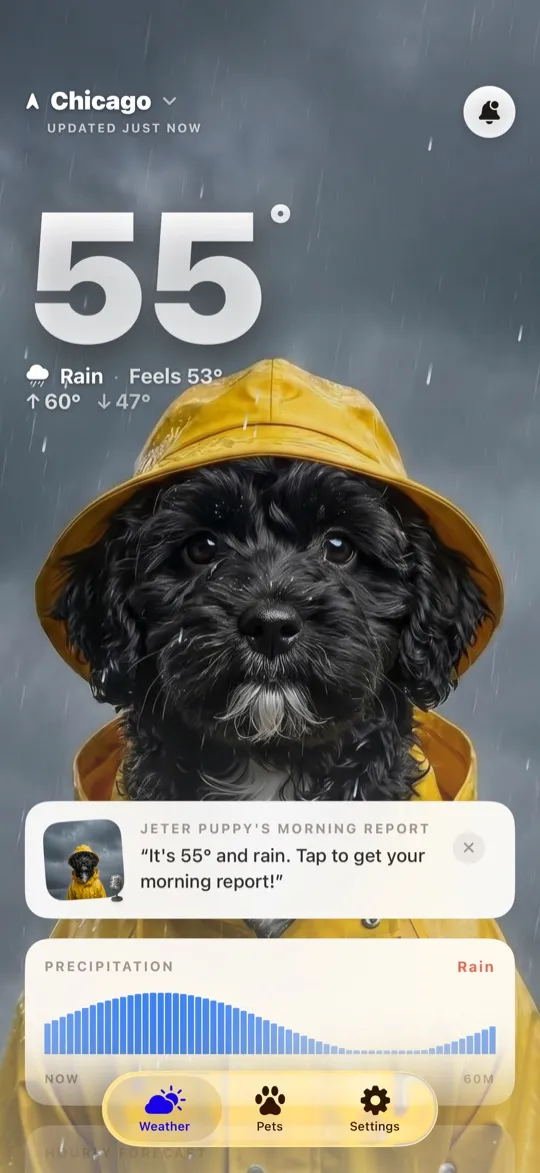
Keeping a picture of them somewhere you pass every day helps more than it should, and there is no rule that it has to be a solemn one. That is roughly how people end up using WeatherPets. It is built around the animals currently tearing about the house, so if there is still somebody in yours, they get to present the day's forecast on your home screen, and the one you lost can turn up in it too, looking exactly as well as the poem describes. Meet your WeatherPet on the App Store.
Frequently asked questions
Who wrote the Rainbow Bridge poem?
Edna Clyne-Rekhy, a Scottish artist from Inverness, wrote it in 1959 as a teenager, the day after her Labrador Major died. She never published it and never put her name on it. The identification was made in 2023 by art historian Paul Koudounaris and reported by National Geographic, supported by her original handwritten manuscript. She was in her eighties before she learned the poem had travelled the world.
When was the Rainbow Bridge poem written?
1959. It then circulated privately for decades, passed between grieving owners as photocopies and typed pages with no author attached. It became globally famous after the Dear Abby advice column printed it in February 1994, which put it in front of an audience estimated at around 100 million readers.
Is the Rainbow Bridge poem religious?
Not in any denominational sense. It borrows the word heaven but describes no doctrine, no deity and no judgement. That is a large part of why it travels so well. People of many faiths and of none read it and find it fits, because what it actually promises is reunion and the end of pain, not a specific afterlife.
Why do so many versions of the Rainbow Bridge poem exist?
Because it spread by copying rather than by publication. For sixty years it moved through vet clinic waiting rooms, newsletters, forwarded emails and message boards, and each hop introduced small edits. There is also a separate rhyming version written by Steve and Diane Bodofsky, which is a distinct work rather than a variant. If two copies you have seen do not match, neither is necessarily wrong.
Can I read the full Rainbow Bridge poem for free?
Yes, it is widely available online, including within National Geographic's reporting on its origin. We link to it rather than reprint it here. The poem was written in 1959 by an author who was living as recently as 2023, so it is very likely still under copyright even though it has been copied freely for decades and no one has ever asserted a claim over it.
Is it normal to grieve a pet as intensely as a person?
Yes, and there is now direct evidence for it. A 2026 study in PLOS ONE found that 7.5 percent of people who had lost a pet met the criteria for prolonged grief disorder, and that among people who had lost both a pet and a human, 21 percent named the pet as their most distressing bereavement. The American Veterinary Medical Association's own policy states that animal loss can cause distress comparable to losing a close human relationship.
Who was credited with the Rainbow Bridge poem before 2023?
Several people, most of them sincerely. Paul Dahm, an Oregon grief counsellor, was widely credited for years. William N. Britton said in 1994 that it had been told to him by a Native American shaman. Dr Wallace Sife, who founded the Association for Pet Loss and Bereavement, believed it was a variant of his own poem. None of these claims survived a look at the handwritten 1959 manuscript.
What does the Rainbow Bridge actually mean?
Read plainly, it says three things: your animal is not in pain any more, your animal is young and well again, and your animal is waiting rather than gone. It is not a claim about the universe. It is a way of holding onto a relationship that did not stop mattering when it stopped being daily, which is exactly what grief researchers describe people needing.
Your daily forecast, delivered by your own pet.

If you are struggling: grief after losing an animal is real grief, and you do not have to sit in it alone. The Tufts Pet Loss Support Helpline is on 508-839-7966, and the Cornell Pet Loss Support Hotline is on 607-218-7457. Both are free and staffed by trained volunteers, and both note that hours can change. If you are having thoughts of harming yourself, please call or text 988 in the US for the Suicide and Crisis Lifeline, which is available at any hour. This article is general information and not a substitute for professional mental health care.